How Long Does SEO Take to Work? Realistic Timelines by Industry
Google says SEO takes four months to a year. Here's what happens month by month, how timelines differ by industry, and how to tell if it's working.
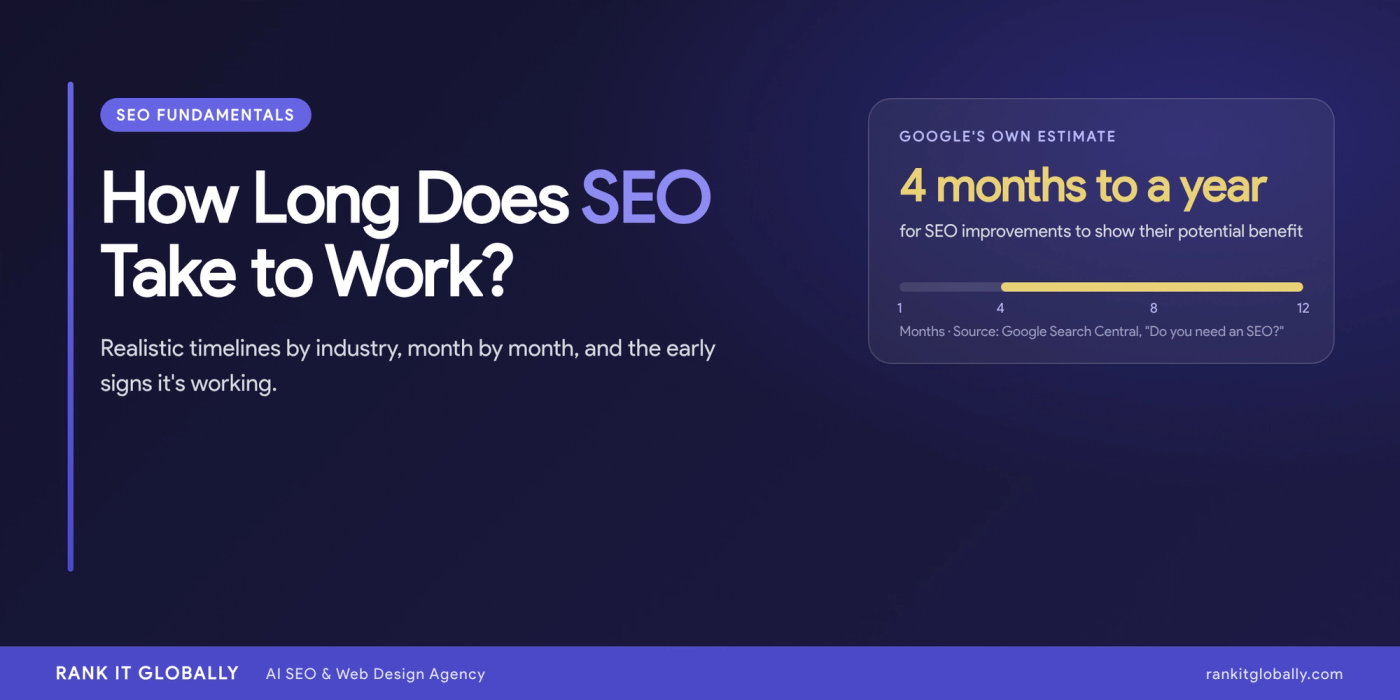
Google says SEO takes four months to a year. Here's what happens month by month, how timelines differ by industry, and how to tell if it's working.
How we put this together: written by Haroon Shahbaz, founder of Rank It Globally. Timelines are based on Google's own guidance, Ahrefs' ranking-age research and Google's documentation on indexing, site moves and updates (all linked in Sources), plus the planning baseline we use with clients.
Disclosure: Rank It Globally sells SEO services. The timelines below apply whoever does your SEO
Quick answer: SEO usually takes four to twelve months to deliver meaningful results. Google's own guidance says SEOs typically need four months to a year to implement improvements and see potential benefit. Local businesses often see measurable movement within 60 to 90 days, while competitive national keywords take longer. Plan for a 12-month horizon.
How long does SEO take? It's the first question almost every business owner asks, and the honest answer is "longer than most people hope, and faster than most people fear." This guide shows what Google and the data say, what happens month by month, how the timeline differs by industry, and how to tell whether your SEO is working before the rankings arrive.
Google has answered this question itself. Its Search Central guide Do you need an SEO? says that in most cases, SEOs need four months to a year to help a business first implement improvements and then see potential benefit. The same guide warns that no one can guarantee a #1 ranking on Google.
Independent data shows why it takes that long. Ahrefs studied how long it takes pages to rank, first in 2017 and again in 2025. The 2025 numbers are sobering:
High-volume keywords took longer to rank for than low-volume ones.
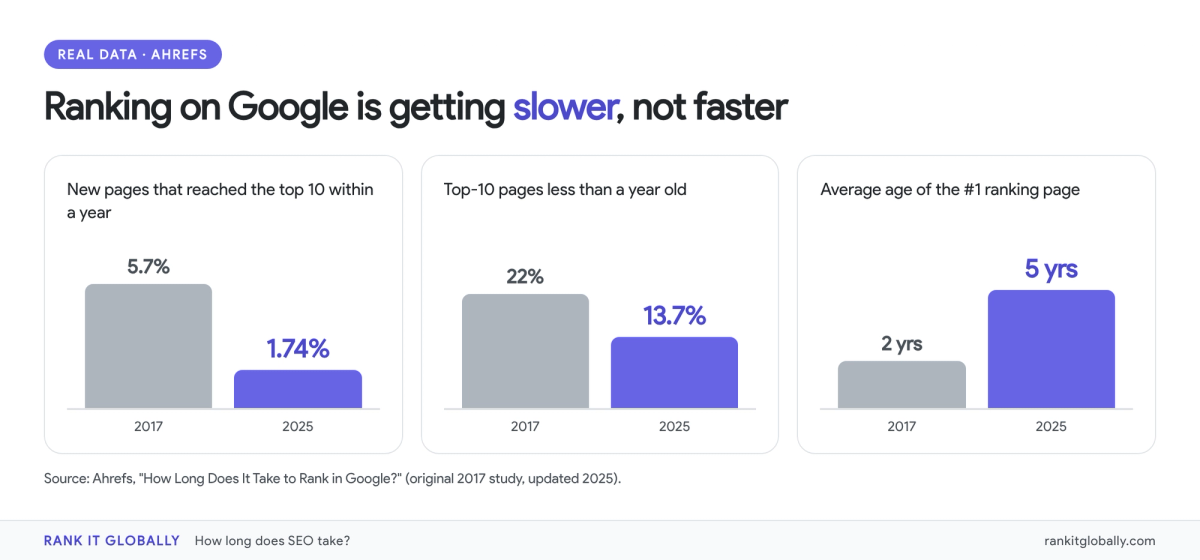
In plain terms: Google rewards pages and sites that have proven themselves over time. A new page competing for a popular keyword is up against pages that have had years to earn links, reviews and trust. That's why smart SEO starts with specific, lower-competition searches and builds toward the big ones.
Every site is different, but a well-run SEO campaign tends to follow the same pattern. Here's what usually happens, and what you should be able to see, at each stage:
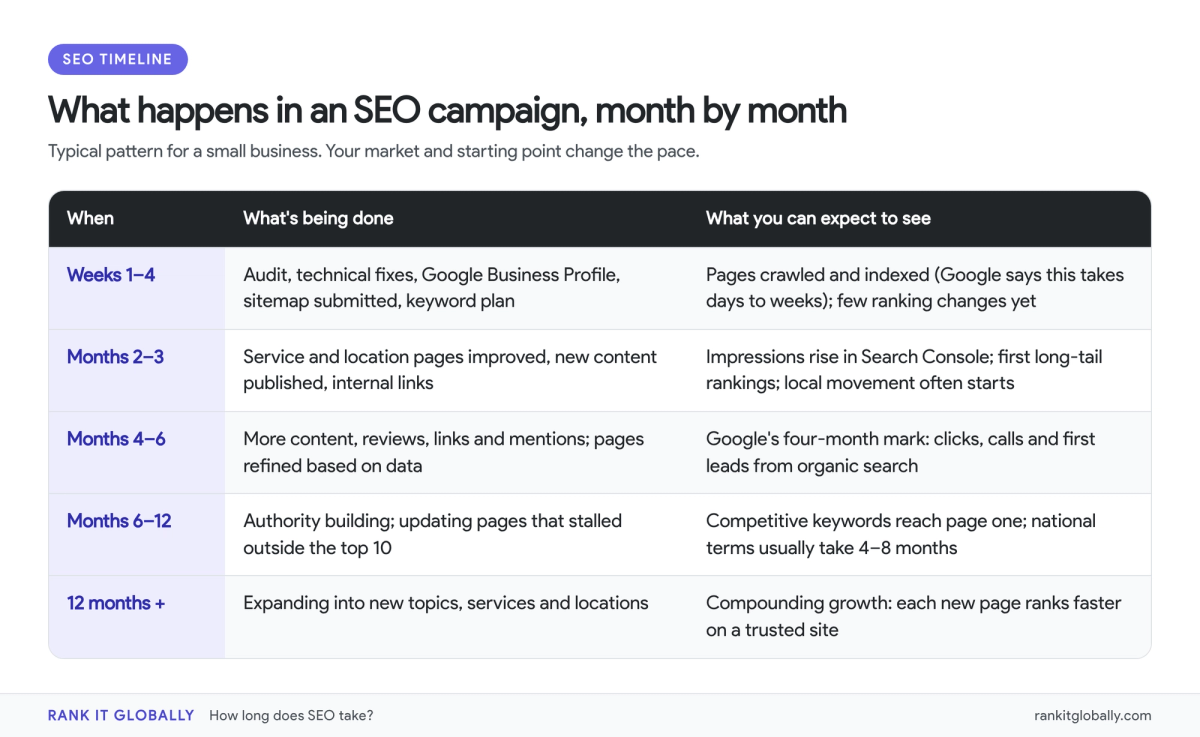
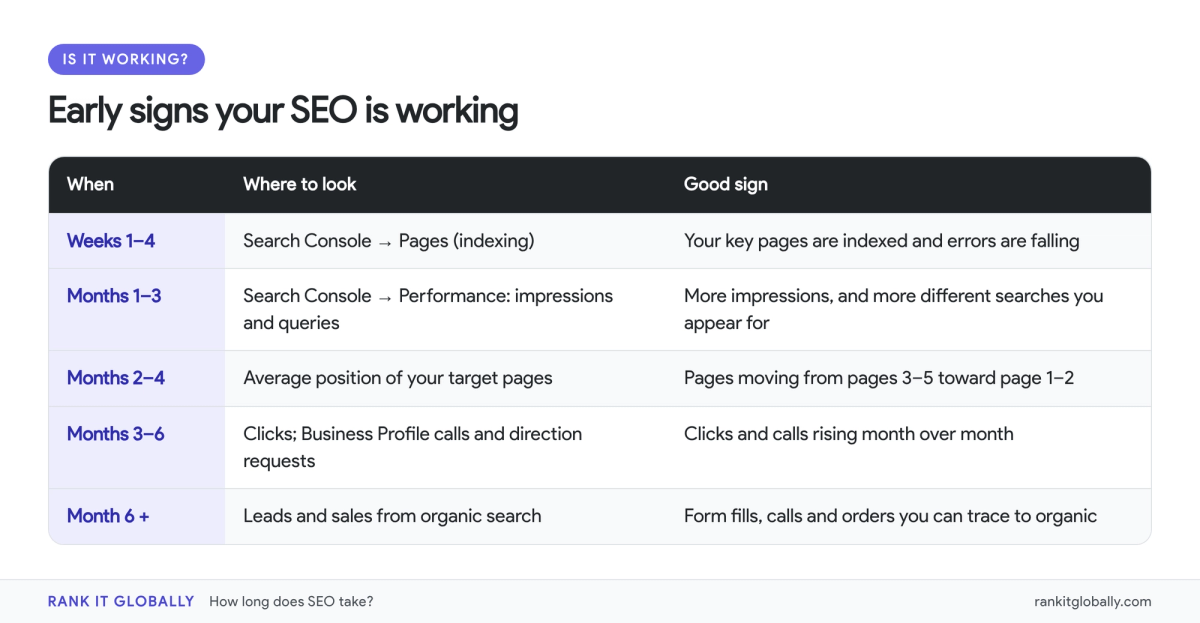
The early work is mostly invisible to customers: fixing how Google reads your site, clarifying what each page is about and building the pages you were missing. Google needs to recrawl those pages, which its documentation says can take anywhere from a few days to a few weeks, and then test where they belong. Rankings tend to climb in steps, not a straight line.
In Google Search Console's Performance report, an impression is counted when your page appears in results, even on page three. As pages climb, impressions grow first; clicks follow once you reach page one, where most clicks happen. Rising impressions with flat clicks in months two to four is a normal, healthy sign.
Industry changes the pace more than almost anything else, because it decides who you're competing with and how carefully Google checks your content. These are the planning ranges we use, anchored to Google's four-to-twelve-month guidance:
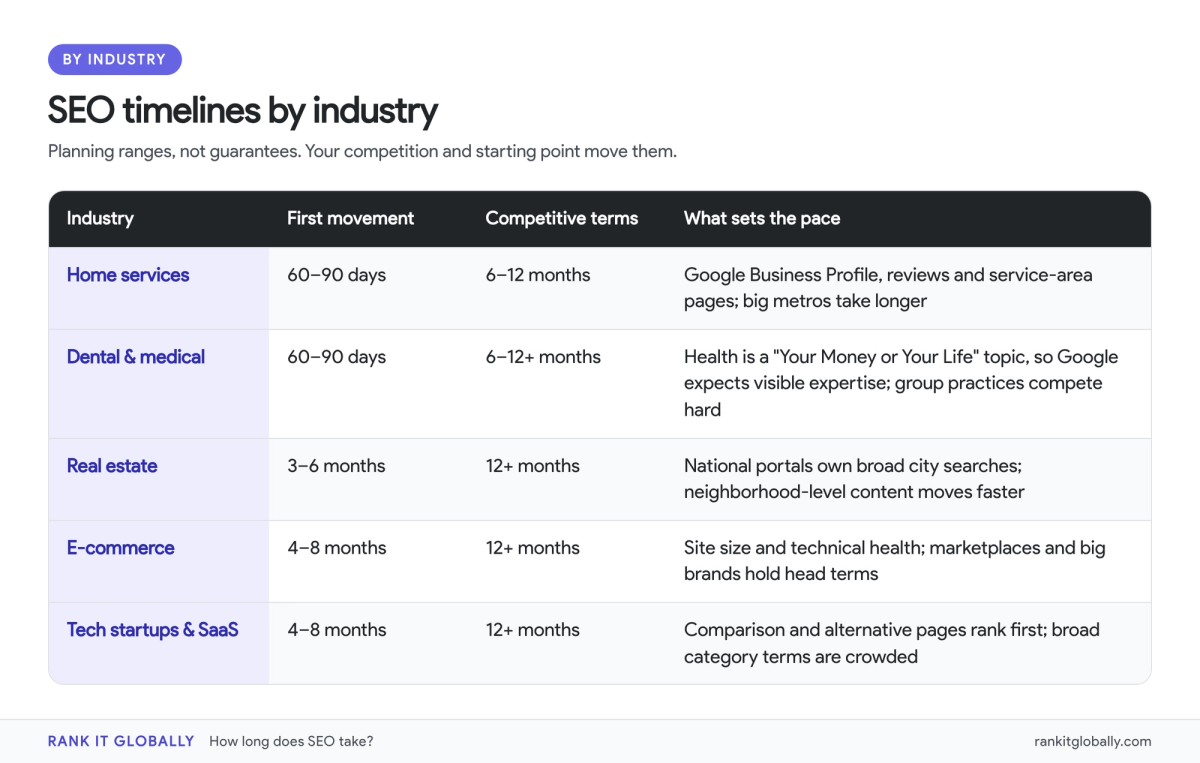
Two patterns stand out. Local businesses move faster because Google ranks local results on relevance, distance and prominence (Google's own explanation), so a nearby business with a strong profile can compete without a national brand's authority. Health, money and legal topics move slower because Google's Search Quality Rater Guidelines hold "Your Money or Your Life" pages to a higher standard of expertise and trust.
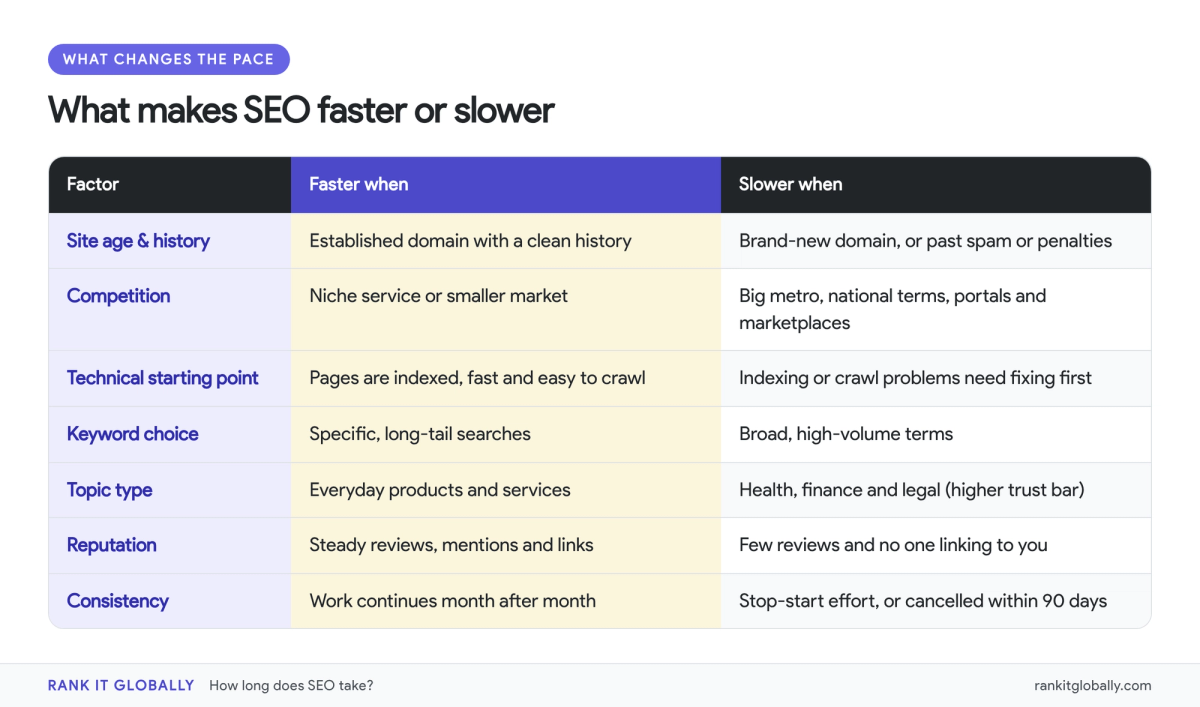
If your site has technical problems, those come first, and they're covered in our guide on why your website doesn't show up on Google. Budget matters too, because it decides how much of this work happens each month; our guide to how much SEO costs breaks down what each budget level typically covers.
Local SEO is usually the fastest way to see results. Google says Business Profile verification can take up to five business days, and edits to a verified profile are usually reviewed within minutes, though some take up to 30 days. After that, movement in the Map Pack depends on your categories, reviews, photos and how well your website supports the profile.
Measurable movement within 60 to 90 days is a realistic baseline for most single-location businesses. Ranking across a whole metro area, rather than just near your address, takes longer because distance is one of Google's three local ranking factors. Our local SEO services page explains how we approach it.
A brand-new website starts with no history, no links and no reviews, so it sits at the slow end of every range above. Google first has to discover and crawl it (days to weeks), then gather enough signals to trust it. Ahrefs' finding that only 1.74% of new pages reach the top 10 within a year applies most strongly here.
A redesign that changes URLs is effectively a site move. Google's site move documentation says a medium-sized website can take a few weeks for most pages to move in its index, larger sites longer, and that ranking fluctuations are normal while that happens. The biggest risk is losing rankings you already had: every old URL needs a 301 redirect to its closest new page. We plan that mapping before launch on every website build.
Google's broad core updates usually take a couple of weeks to roll out. If your rankings dropped, Google's core update guidance explains that improvements can take several months to be reflected, and Google has said some sites may not fully recover until the next core update. Recovery is real, but it's measured in months, not days, and it depends on genuinely improving the site rather than tweaking keywords.
Don't wait twelve months to find out. These signals, all free in Google Search Console and your Google Business Profile, show whether you're on track:
Want to know where you're starting from? Download the free SEO Readiness Scorecard (PDF): 20 yes-or-no checks that show whether your site is set up for the faster or slower end of these timelines.
Be wary of anything sold as a shortcut. Bought links, mass-produced pages and guaranteed rankings can bring short spikes, then penalties that set you back far longer than doing it properly.
Here's what established SEO campaigns produce. These Search Console reports are from two of our clients over the same 90 days, unedited:
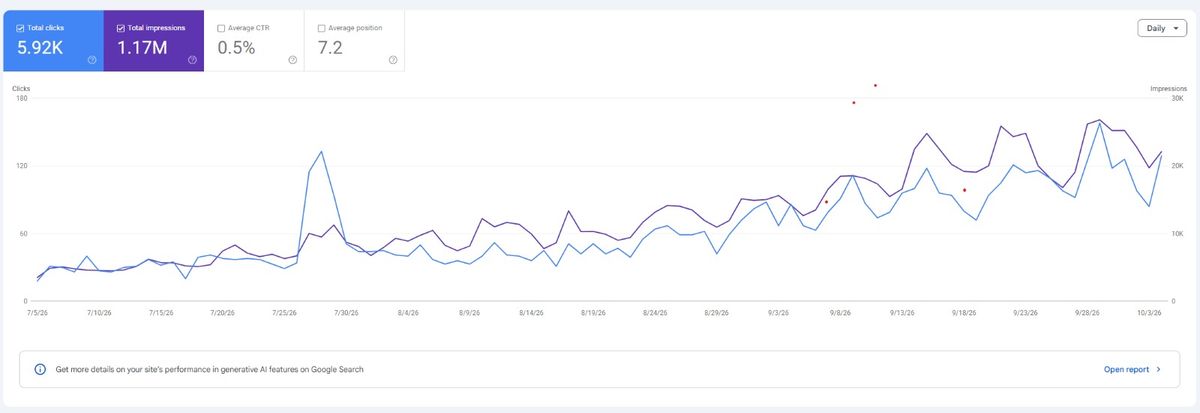
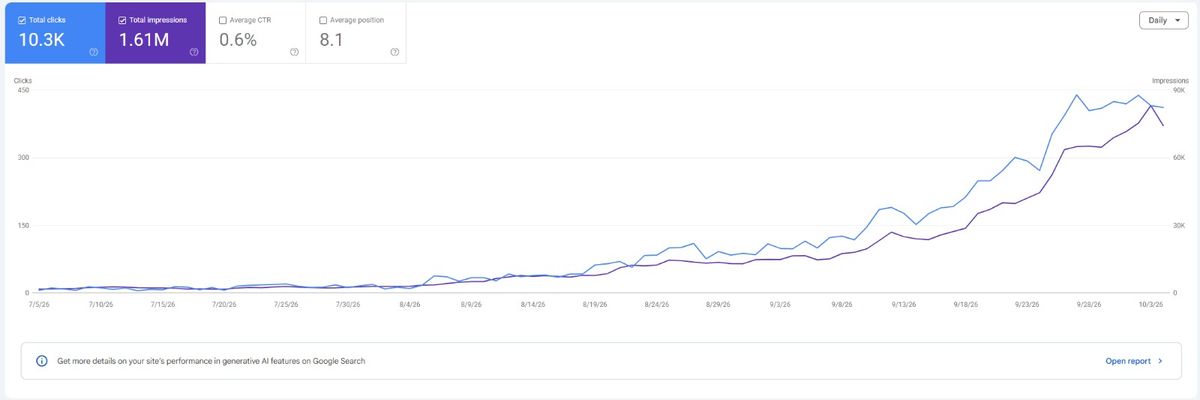
Neither result appeared in month one. Both sites reached this point after the foundations, content and authority work described above had time to compound. Across our client work, most clients investing $2,000 to $4,000 per month reach positive ROI by month four to six. Clients who stop within the first 90 days almost never see meaningful results, regardless of the quality of the work. More results are on our case studies page.
Give any new SEO campaign at least six months before judging it on rankings and leads, and judge it on the leading indicators above before then. A six-month commitment is reasonable; a 12-month lock-in with no track record isn't. We work on an initial six-month period, then month to month. Whoever you hire, ask to see Search Console data, not just a rank report, and ask what month one will include. It should be an audit and a prioritized plan.
If you'd like a clear starting point, our free Growth Audit checks your site's technical health, content gaps and local presence, and shows where you sit on these timelines today.
SEO takes four to twelve months to show its real value, sooner for local searches and longer for competitive national ones. The businesses that win aren't the ones that find a shortcut; they're the ones that start early, measure the right signals and keep going. If you're also wondering whether AI search changes these timelines, our guide to GEO vs SEO covers how the two work together.
Common Questions
Most businesses see measurable movement within three to six months and stronger results within six to twelve months. Google's own guidance says SEOs typically need four months to a year to implement improvements and see potential benefit. Local searches usually move sooner, and competitive national keywords take longer.
Some fixes show within weeks, such as getting blocked pages indexed or completing a Google Business Profile. Meaningful growth in rankings and leads almost never happens in 30 days. Google says no one can guarantee a #1 ranking, so treat 30-day promises as a red flag.
Local SEO usually shows measurable movement within 60 to 90 days for a single-location business. Google Business Profile verification can take up to five business days, and ranking across a whole metro area takes longer because distance is one of Google's local ranking factors.
A new website usually needs six to twelve months before it competes with established sites. Google first has to crawl it, which can take days to weeks, and then build trust. In Ahrefs' 2025 data, only 1.74% of new pages reached the top 10 within a year.
That's a normal early sign of progress. Search Console counts an impression whenever your page appears in results, even on page three. Clicks usually follow once pages reach page one, where most clicks happen.
Give a new SEO campaign at least six months before judging it on rankings and leads. Before that, judge it on leading indicators in Search Console, such as indexed pages, impressions and average position. A 12-month lock-in with no track record isn't necessary.
Share

ChatGPT now names businesses when people ask who to hire. Here's the 8-step process to make sure it can find, trust and recommend yours.

SEO gets you ranked. GEO gets you recommended. Here's how ChatGPT, Perplexity and Gemini decide which businesses to name, and the four signals you control.

Your site isn't on Google's first page - here are the real reasons why, ranked by impact, with the exact fixes to apply first so you stop losing leads to competitors.