How Much Does SEO Actually Cost? (An Agency's Honest Breakdown)
Stop guessing SEO pricing. We break down every tier — $500/month to $30K+ — with real numbers and what you actually get at each level. No fluff, no hidden fees.
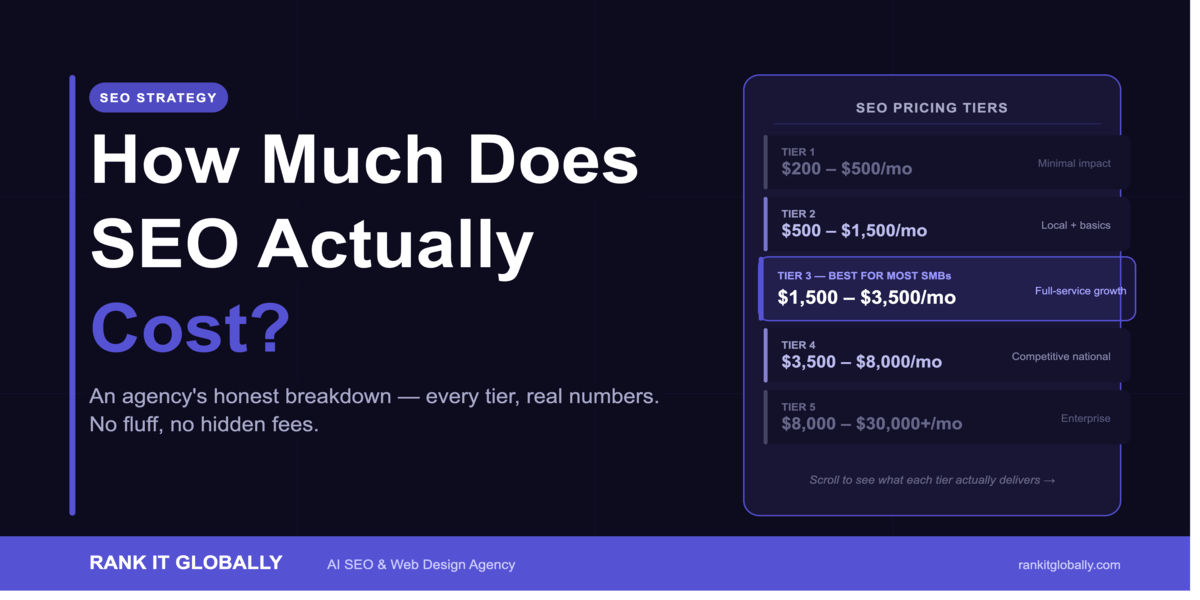
Stop guessing SEO pricing. We break down every tier — $500/month to $30K+ — with real numbers and what you actually get at each level. No fluff, no hidden fees.
Key Takeaways:
- Average monthly SEO cost in 2026: $3,199 (source: Clutch.co)
- Freelancers average $71.59/hour, agencies $98.90/hour, consultants $171.18/hour (source: Ahrefs 2026 survey of 439 SEO professionals)
- Most small and medium businesses pay between $1,500 and $5,000 per month
- Local SEO starts at $300 to $2,000/month
- SEO typically takes 3 to 6 months to show measurable movement
- 53% of all website traffic comes from organic search (source: BrightEdge)
SEO costs between $500 and $30,000 per month depending on the scope of work, the competitiveness of your market, and whether you hire a freelancer, an agency, or build an in-house team. For most small and medium businesses, a full-service monthly SEO retainer falls between $1,500 and $5,000 per month.
According to Clutch.co's April 2026 data, the average monthly SEO cost across US agencies is $3,199. Ahrefs' 2026 pricing survey of 439 SEO professionals confirmed similar numbers — agencies average $98.90 per hour, freelancers come in at $71.59 per hour, and consultants charge around $171.18 per hour.
The wide range exists because "SEO" is not one service. It is a combination of technical work, content creation, link building, and ongoing reporting. A $500 per month package and a $3,000 per month package are not the same service at different prices. They are entirely different products with different outcomes.
This breakdown covers every pricing tier, what you actually receive at each level, and how to decide what your business should budget for SEO services that match your growth goals.
SEO pricing varies because the discipline covers multiple specialisms that can each be scoped in or out of a retainer. When someone asks "how much does SEO cost per month," the honest answer depends on how many of these components are included.
Technical SEO ensures search engines can crawl, index, and understand your website. It covers page speed, Core Web Vitals, schema markup, site architecture, and mobile performance. A site with serious technical debt — slow load times, broken internal links, poor crawlability — requires more hours in this area before any content or link work can produce results.
On-page SEO is the optimisation of individual pages for specific keywords. It includes meta titles, meta descriptions, heading structure, keyword placement, internal linking, and content quality. This is where most SEO companies spend the majority of early-stage effort.
Content creation is the production of blog posts, landing pages, and pillar content that targets informational and commercial search queries. According to Clutch and Upwork market data, freelance content rates for SEO range from $0.15 to $0.50 per word, while agency-produced content within a retainer typically runs $150 to $1,000 per piece depending on length and industry expertise required.
Link building is the process of earning backlinks from authoritative third-party websites. Backlinks remain one of the strongest signals Google uses to determine rankings. Quality link building is also one of the most labour-intensive and expensive components of SEO, which is why cheap packages either skip it entirely or use spammy shortcuts.
Local SEO is optimisation specifically for businesses targeting customers in a geographic area. It includes Google Business Profile management, local citation building, review generation, and location-specific landing pages. More on local SEO costs below.
AI Search Optimisation and Answer Engine Optimisation (AEO) is a newer discipline focused on getting content cited in Google AI Overviews, ChatGPT, Perplexity, and Gemini. According to SEO Sherpa's 2026 data, Google AI Overviews now appear on more than 13% of all desktop queries — a figure that doubled in under three months. This means businesses that ignore AEO are losing visibility to competitors who structure content specifically for AI extraction.
A $500 per month package may cover only one or two of these components. A $4,000 per month retainer typically covers all of them. Price differences reflect scope, not arbitrary markup.
Before looking at pricing tiers, it helps to understand how SEO services are billed. Ahrefs' 2026 survey found that 78.2% of SEO providers charge a monthly retainer, making it the dominant model. But three pricing structures exist, and each fits different situations.
Monthly retainers range from $500 to $10,000+ per month. You pay a fixed monthly fee for an agreed scope of ongoing work. This is the most common model because SEO requires consistent, compounding effort — not a one-time fix. Most businesses generating consistent revenue should default to this model.
Hourly consulting ranges from $50 to $300 per hour. Freelancers average $71.59 per hour, agencies average $98.90 per hour, and specialist consultants charge $150 to $300 per hour (source: Ahrefs 2026 survey). Hourly pricing works well for targeted help — a technical audit, a consulting call, or a keyword strategy session.
Project-based pricing ranges from $1,000 to $50,000 depending on scope. Projects have a clear start and end point — a site migration, a complete audit, a content sprint. Many project engagements transition into ongoing retainers once the initial work is complete.
The model you choose matters less than whether the scope matches your goals. A $2,000 monthly retainer with clear deliverables will outperform a $5,000 project that sits on a shelf.
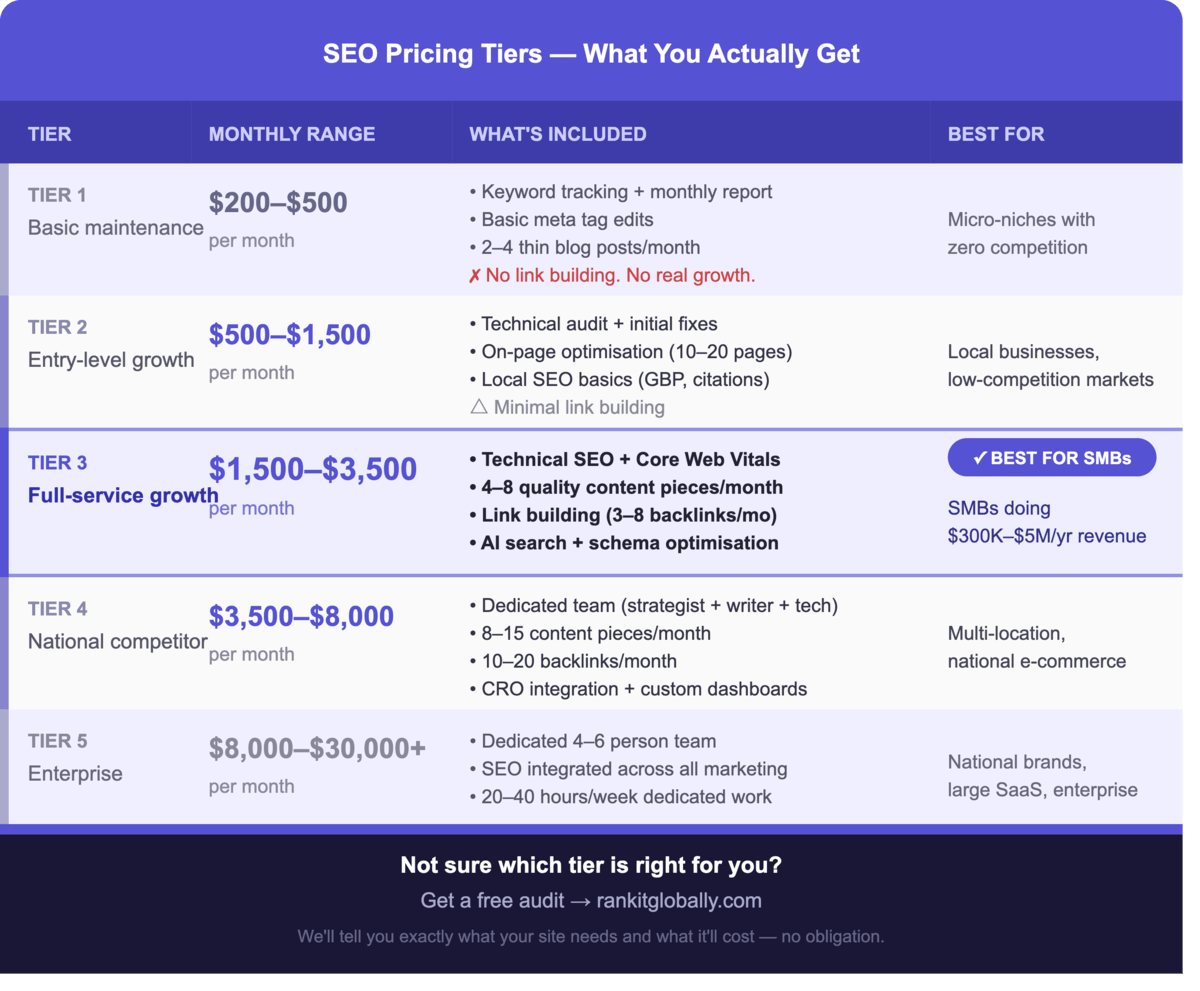
This is the entry point for meaningful SEO work. At this budget, a business should receive an initial technical audit and fixes, on-page optimisation for ten to twenty pages, basic local SEO including Google Business Profile setup and citation building, and monthly reporting on rankings, traffic, and conversions.
Link building remains limited or absent at this level. Results on low-competition keywords are achievable within three to six months. Competing against established businesses on high-volume terms is not realistic at this budget.
This tier works for small businesses in low-competition markets or those focused exclusively on local SEO in a single service area.
This is the range where compounding SEO growth becomes achievable for most small and medium businesses. A retainer at this level should include comprehensive technical SEO work covering Core Web Vitals, schema markup, and site architecture. It should also include four to eight pieces of original content per month, active link building producing three to eight quality backlinks monthly, AI search optimisation and FAQ schema, conversion tracking, and monthly strategy calls.
For businesses generating between $300,000 and $5 million in annual revenue, this tier typically delivers the strongest return on investment. Initial traction is visible within two to four months. Compounding results typically become clear between months six and nine.
Search Engine Journal's State of the SEO Agency report found that approximately one-third of businesses pay between $1,000 and $5,000 per month, with this middle tier producing the most consistent ROI for growth-stage companies.
At this level, a business receives a dedicated SEO team rather than a shared resource pool. That team typically includes a strategist, content writer, technical SEO specialist, and link builder. Output includes eight to fifteen content pieces per month, ten to twenty backlinks per month, custom reporting dashboards, CRO integration, and dedicated account management.
This budget is appropriate for national-market competitors, multi-location businesses, and e-commerce stores with significant organic revenue at stake.
AI Overview and answer engine optimisation becomes a serious focus at this tier. Getting content cited in Google AI Overviews, Perplexity, and ChatGPT requires the volume and quality of content production that lower budgets cannot support.
Enterprise SEO. This is a dedicated team of four to six specialists working twenty to forty hours per week, with SEO integrated across the entire marketing function. National brands, large e-commerce operations, and SaaS companies with significant organic acquisition targets operate at this level.
The majority of businesses asking how much SEO costs do not need this tier. If you are generating under $10 million in annual revenue, the $1,500 to $5,000 range will serve you better.
Enterprise SEO. This is a dedicated team of four to six specialists working twenty to forty hours per week, with SEO integrated across the entire marketing function. National brands, large e-commerce operations, and SaaS companies with significant organic acquisition targets operate at this level.
The majority of businesses asking how much SEO costs do not need this tier.
Local SEO costs between $300 and $5,000 per month depending on the number of locations, the competitiveness of your market, and the scope of services included.
For a single-location business, local SEO typically runs $500 to $2,000 per month. This covers Google Business Profile optimisation, citation building and NAP consistency, review generation strategy, local schema implementation, and geo-targeted content creation.
Multi-location businesses pay more because each location requires its own GBP listing, location-specific landing pages, individual citation profiles, and separate review management. Businesses with five or more locations should budget $2,000 to $5,000 per month for comprehensive local SEO.
Local SEO produces faster results than national SEO. Most businesses see measurable movement in Google Maps and local pack rankings within 60 to 90 days. For service-based businesses in specific markets — a law firm in Bellevue, a dental practice, a restaurant — local SEO is almost always the highest-ROI starting point.
Industry competition directly affects how much you should budget for SEO. Highly competitive industries require more aggressive content, stronger backlink profiles, and larger budgets to compete.
Legal services: $2,500 to $10,000 per month. Law firm keywords carry some of the highest CPCs in Google Ads — some exceeding $200 per click. This makes organic SEO particularly valuable for attorneys, but the competition for those rankings is equally intense. A law firm SEO strategy typically requires dedicated practice area pages, attorney bio optimisation, and aggressive local SEO.
Healthcare and dental: $2,000 to $8,000 per month. Medical practices face additional complexity from HIPAA compliance requirements and Google's stricter E-E-A-T standards for health-related content. Dental practices in competitive metro areas often need $2,000 to $4,000 per month minimum.
Real estate: $1,500 to $5,000 per month. Agents compete against Zillow, Redfin, and Realtor.com — sites with massive domain authority. Winning in real estate SEO means building hyperlocal content targeting neighbourhood-specific queries where the national portals are weaker.
E-commerce: $2,000 to $10,000 per month. E-commerce SEO involves product page optimisation, category architecture, faceted navigation management, product schema markup, and handling out-of-stock pages. The technical complexity alone puts this above most other industries.
Tech and SaaS: $3,000 to $15,000 per month. [Tech startups] need product-led content, comparison pages, integration documentation, and programmatic SEO — all of which require specialised expertise.
Home services: $1,000 to $3,000 per month. Plumbing, HVAC, electrical, and roofing companies compete heavily on "near me" and city-specific queries. Local SEO drives the majority of results in this vertical.
The pattern is clear: the higher the value of a single customer, the higher the cost of SEO to acquire that customer. A law firm where one case is worth $50,000 can justify a $5,000 monthly SEO budget far more easily than a restaurant where the average ticket is $40.
Three options exist for executing SEO, and each carries a different cost structure.
Hiring in-house: An SEO specialist in the US earns $60,000 to $120,000 per year in salary, with SEO managers earning $100,000 to $180,000 per year (source: Glassdoor, LinkedIn Salary data). Add benefits, payroll taxes, and tool subscriptions ($200 to $500 per month for Semrush or Ahrefs alone), and a single in-house hire costs $80,000 to $150,000 annually. That is $6,600 to $12,500 per month — for one person. You still need a content writer, a link builder, and a technical specialist to run a full programme.
Hiring an agency: $1,500 to $10,000 per month. You get a full team — strategist, writer, technical specialist, link builder, account manager — for less than the cost of a single in-house hire. Agencies bring cross-client learning, established processes, and immediate execution capacity. The tradeoff is less control over day-to-day priorities.
Hiring a freelancer: $500 to $3,000 per month. Freelancers work well for narrow scopes — technical audits, content production, consulting sessions. The limitation is capacity. One person cannot execute a complete SEO programme across technical, content, link building, and reporting simultaneously.
We have operated on both sides of this equation. Our founder built the agency after years of freelance SEO work on Upwork, delivering results across 150+ client engagements. That experience — knowing exactly what a solo practitioner can and cannot accomplish — is what shaped our agency model. We built RankitGlobally to deliver freelancer-quality attention with agency-level execution capacity.
For most small and medium businesses, an agency retainer between $2,000 and $5,000 per month delivers the best balance of expertise, capacity, and cost efficiency.
If you plan to manage SEO internally, these are the tools you will need and what they cost:
Keyword research and rank tracking: Semrush ($139.95 to $499.95/month), Ahrefs ($129 to $449/month), or Moz Pro ($99 to $599/month). You need at least one of these. Free alternatives exist (Google Search Console, Ubersuggest free tier) but lack the depth required for competitive analysis.
Technical auditing: Screaming Frog ($259/year for the paid version) or Sitebulb ($35 to $65/month). Google Search Console covers basics for free, but a dedicated crawler catches issues GSC misses.
Local SEO management: BrightLocal ($39 to $79/month) or Whitespark ($39 to $149/month) for citation tracking and local rank monitoring.
Content optimisation: Surfer SEO ($99 to $249/month) or Clearscope ($170+/month) for content scoring and keyword optimisation.
Reporting: Google Analytics 4 (free), Google Looker Studio (free), or AgencyAnalytics ($79 to $239/month) for client-facing dashboards.
Total minimum tool cost for DIY SEO: approximately $300 to $700 per month. This does not include your time. Competitive SEO requires ten to twenty hours per week when done properly. Most business owners generate more value spending that time on their core business.
Not every business needs an ongoing SEO retainer. Some situations are better served by scoped projects.
An SEO audit costs between $500 and $5,000 depending on site size and depth. It delivers a full technical and content analysis with a prioritised action plan. This is the right starting point for any business that wants to understand its current position before committing to ongoing work. Our free SEO audit covers technical foundations, current keyword positions, content gaps, and conversion setup.
Website migration SEO costs between $1,000 and $5,000 and protects existing rankings when a site is redesigned or moved to a new domain. This is one of the most underestimated services in the industry — failing to do it properly can destroy years of ranking progress overnight.
Local SEO setup costs between $500 and $2,000 as a one-time engagement. It covers Google Business Profile optimisation, citation cleanup, and local schema implementation. Suitable for businesses that want to handle ongoing maintenance themselves after a proper foundation is in place.
A content sprint costs between $1,500 and $5,000 and produces ten to twenty content pieces in a single production run. This works for launching a new blog strategy or filling identified topical gaps quickly.
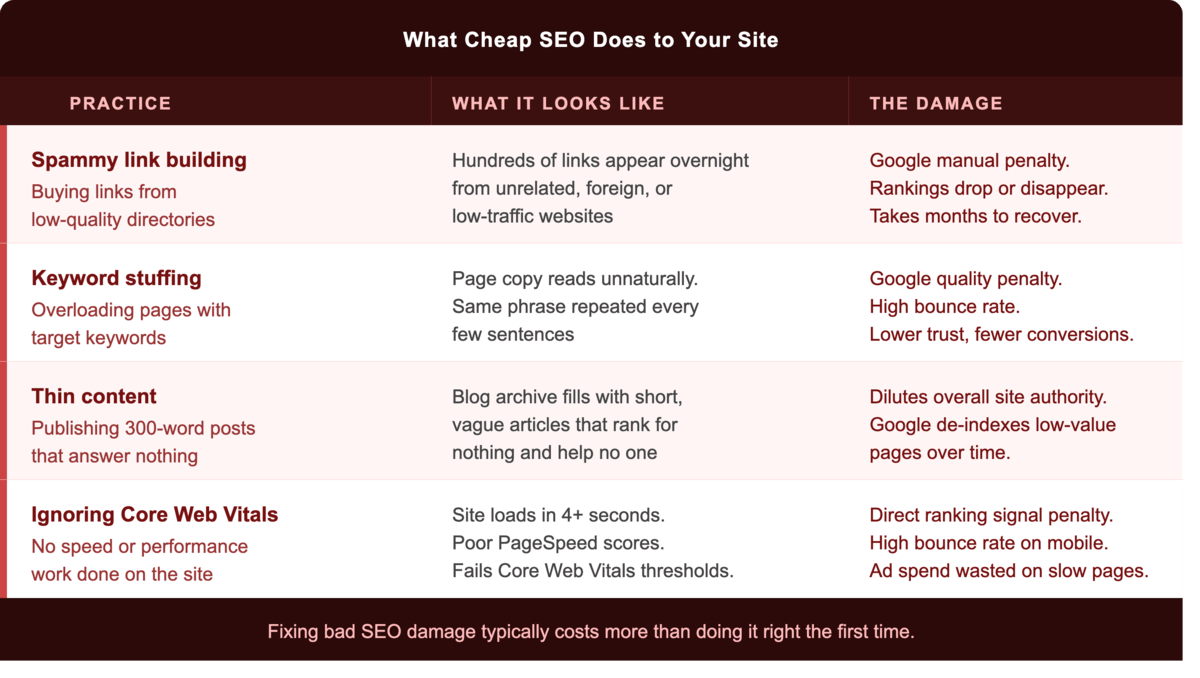
Low-cost SEO does not simply fail to deliver results — it can leave a site in a materially worse position than before the work began. The four most common forms of damage are worth understanding because the cost to reverse them routinely exceeds the amount saved by choosing the cheaper provider.
Spammy link building involves purchasing links from low-quality or irrelevant directories. Google's algorithms detect unnatural link patterns and can apply a manual or algorithmic penalty, causing rankings to drop significantly. Recovering from a link penalty requires a disavow process that can take three to six months.
Keyword stuffing is the practice of overloading page content with target keywords to the point where the text reads unnaturally. Google's helpful content system penalises pages that appear written for algorithms rather than people.
Thin content refers to blog posts and pages of fewer than 500 words that provide little informational value. Publishing large volumes of thin content dilutes a site's overall authority and can trigger broad core algorithm demotions.
Ignoring Core Web Vitals means the site's speed and user experience metrics remain below Google's recommended thresholds. Core Web Vitals are a confirmed Google ranking signal, and poor scores directly affect both rankings and conversion rates.
We have rebuilt sites for businesses that spent eighteen months with a low-cost agency and finished with worse rankings than when they started. The cost to reverse that damage — technical remediation, link disavows, content rewrites — routinely exceeds the total amount saved by choosing the cheaper provider.
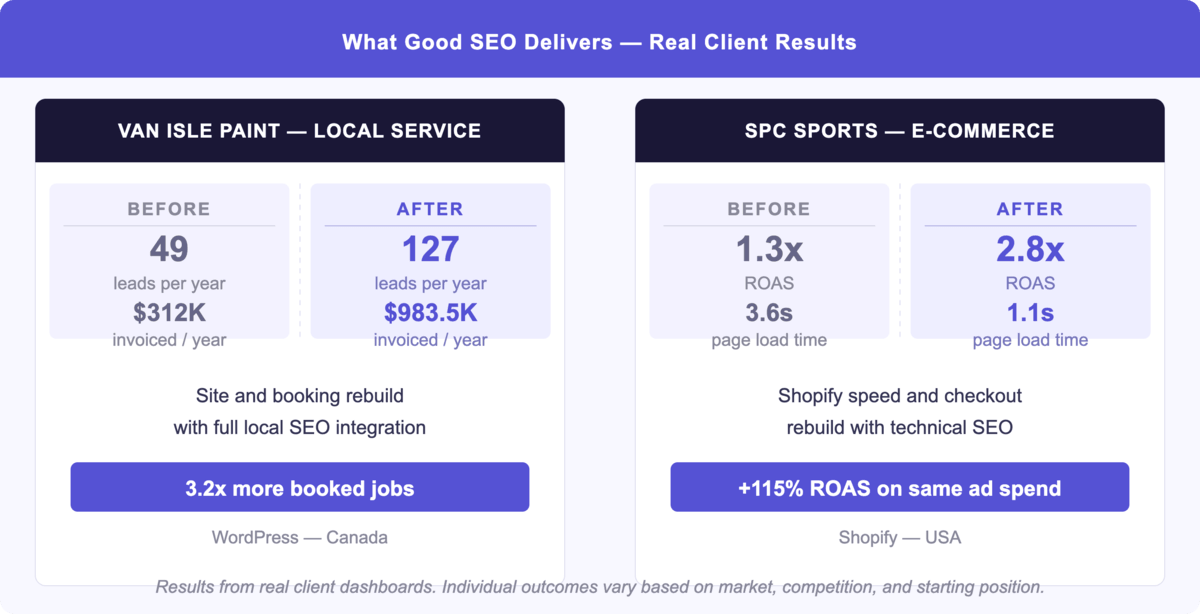
Van Isle Paint — local service business, Canada. When we began work, the business was generating 49 leads per year and invoicing $312,000 annually. After a full site rebuild with integrated local SEO — Google Business Profile optimisation, service area landing pages, a review generation strategy, and local schema — leads increased to 127 per year and annual invoiced revenue reached $983,500. The site rebuild was the vehicle; the SEO strategy drove the outcome.
SPC Sports — e-commerce, USA. The site was loading in 3.6 seconds and returning a ROAS of 1.3x on $78,000 per month in ad spend. After a Shopify speed and checkout rebuild with technical SEO improvements, load time dropped to 1.1 seconds, cart abandonment fell from 47% to 24%, and ROAS increased to 2.8x — a 115% improvement on the same advertising budget.
Neither result came from SEO applied as a layer on top of an existing site. Both came from SEO built into the site architecture from day one.
BrightEdge research shows that organic search drives 53% of all website traffic. That means more than half of every potential customer finding your business online arrives through organic search — not paid ads, not social media, not direct traffic.
Here is how the ROI math works for a typical local service business:
If one new client is worth $3,000 in lifetime value and your SEO campaign delivers five new clients per month, that is $15,000 in monthly revenue from a $2,500 SEO investment. That is a 6x return.
Now compare that to Google Ads for the same keywords. If the average cost per click is $15 and your conversion rate is 5%, each new client costs $300 in ad spend. But the moment you stop paying, traffic drops to zero. SEO compounds — the rankings you build in month three continue producing traffic in month twelve and beyond at zero additional cost per click.
At Rank It Globally, most clients investing between $2,000 and $4,000 per month reach positive ROI by month four to six and see a three to five times return within twelve months. These are observed outcomes across 150+ client engagements spanning our freelance and agency work, not projections. Check our SEO pricing packages for specific deliverables at each level.
Seven factors determine what you will actually pay for SEO:
Before you commit budget to any agency, ask these five questions. The answers will tell you more about the agency than their website ever will.
1. Which specific keywords are we targeting and why?
A credible agency should name ten to fifteen target keywords with a rationale covering search volume, keyword difficulty, and the business intent behind each term. A generic answer means they are following a template rather than building a strategy.
2. How do you build backlinks?
Backlink building should involve editorial outreach — contacting relevant websites and offering content or commentary in exchange for links. If the answer references directory submissions, link packages, or PBNs, end the conversation.
3. How do you measure success beyond keyword rankings?
Keyword position is a leading indicator. The real measures of SEO success are organic traffic, lead volume, and revenue. An agency that tracks only rankings is not measuring the right outcomes.
4. Can I see before and after metrics from a comparable business?
Not logo walls or case study titles — actual numbers. Traffic change, lead volume change, revenue impact. If they cannot show this, they likely do not have it.
5. What does month one look like?
The first month of any serious SEO engagement should be an audit and a prioritised plan. If month one is four blog posts with no technical work, the agency is skipping the diagnostic step that every effective strategy requires.
If you want to dig deeper into agency selection, read our guide on how to choose an SEO company — we cover seven red flags that signal you should walk away.
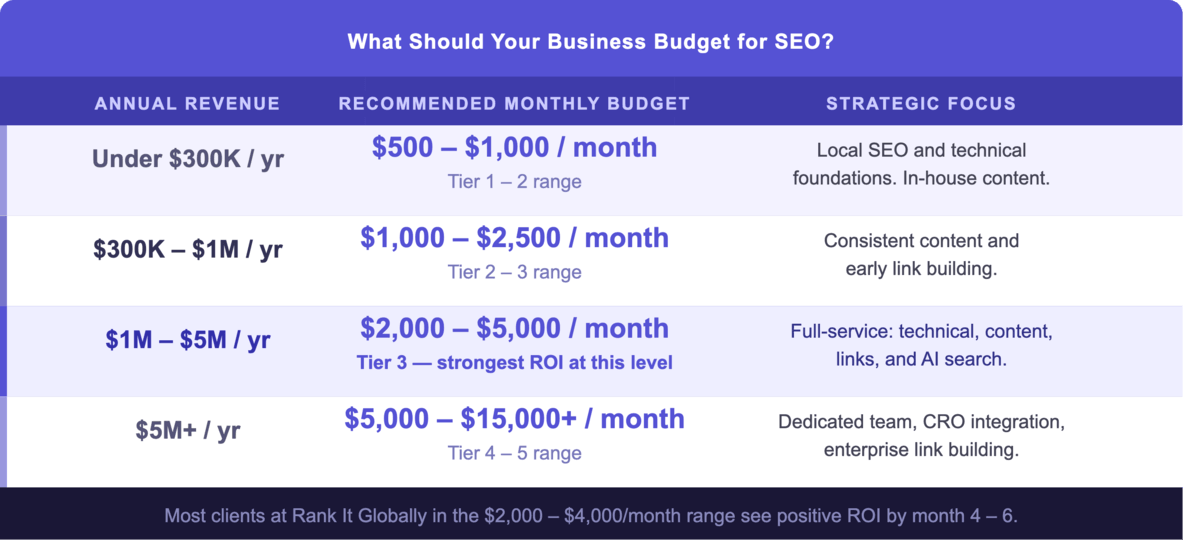
A practical framework based on business revenue:
Under $300,000 per year: Budget $500 to $1,000 per month. Focus on local SEO, technical foundations, and creating content in-house where possible. At this stage, a free SEO audit is the right first step to understand where your site stands.
$300,000 to $1 million per year: Budget $1,000 to $2,500 per month. Consistent content production and early link building begin moving rankings. This is where most small businesses start seeing measurable returns from organic search.
$1 million to $5 million per year: Budget $2,000 to $5,000 per month. At this revenue level, the cost of not ranking is significant. A full-service approach covering technical SEO, content, links, and AI search optimisation is justifiable and typically returns three to five times the investment within twelve months.
Over $5 million per year: Budget $5,000 to $15,000 per month or more depending on market competitiveness and organic revenue targets.
The biggest mistake is buying based on monthly price instead of required scope. The second biggest mistake is expecting a small budget to overcome a large competitive gap. SEO works best when the budget matches the market reality from the beginning.
Is SEO worth it for small businesses?
Yes, provided the business commits to at least six to twelve months of consistent activity. SEO is a compounding investment — the results in month nine are built on the work done in months one through eight. Businesses that cancel within the first ninety days almost never see meaningful results, regardless of the quality of the work.
How long does SEO take to show results?
Local SEO typically produces measurable movement within 60 to 90 days. Competitive national keywords require four to eight months before consistent first-page rankings appear. Planning for a twelve-month horizon is the realistic baseline. Read more in our guide on how long SEO takes to work
How much does SEO cost for a small business per month?
Most small businesses pay between $500 and $3,500 per month for ongoing SEO services. The exact cost depends on competition level, geographic scope, and how much of the work (especially content creation) is handled internally versus outsourced. Businesses in competitive industries like legal or healthcare should budget toward the higher end.
Can a business do its own SEO?
Yes. The fundamentals of on-page SEO and local SEO are learnable, and many small businesses manage basic optimisation in-house. The constraint is time — competitive SEO requires ten to twenty hours per week when done properly. The tool costs alone run $300 to $700 per month. Most business owners generate more value spending that time on their core business.
What is the difference between SEO and Google Ads?
Google Ads produce traffic immediately but stop producing traffic the moment spending stops. SEO builds rankings that generate traffic indefinitely. Both serve different objectives: paid search for immediate lead generation, organic search for long-term traffic at zero marginal cost per click. We compare both approaches in detail in our post on SEO vs PPC.
Should I sign a long-term SEO contract?
A commitment of six months is reasonable because SEO requires that much time to produce measurable results. A contractual lock-in of twelve months or more — particularly without a track record of results from the agency — is not necessary and not advisable. We operate on a month-to-month basis after an initial six-month period.
Why is SEO so expensive?
Quality SEO requires a team of specialists — a strategist, a content writer, a technical specialist, and a link builder — each working ten to twenty hours per month on your account. Add tool costs ($200 to $500/month per tool), content production costs ($150 to $1,000 per piece), and link acquisition costs, and the labour hours alone justify the pricing. Cheap SEO is cheap because it cuts the components that actually produce results.
How do I know if my current SEO is working?
Open Google Search Console and review the Performance report for the last twelve months. Look at the trend in total impressions, total clicks, and average position. If impressions are growing but clicks are flat, the issue is your meta titles and descriptions. If both are flat or declining, the content or technical foundations are the problem. If your current agency cannot interpret these numbers for you, that is a problem.
What is the cost of not doing SEO?
Every month without an optimised web presence is a month where competitors build organic ranking advantages that compound over time. The cost is not a line-item expense — it is the revenue that does not materialise from the searches your potential customers conduct right now. With organic search driving 53% of all web traffic (source: BrightEdge), the invisible cost of inaction is often larger than any SEO retainer.
SEO pricing ranges from $500 to $30,000 per month because "SEO" covers a wide range of activities with very different levels of execution, expertise, and time investment.
For most small and medium businesses, the right starting point is a technical audit to establish where the site currently stands, followed by a full-service retainer in the $1,500 to $3,500 per month range once the gaps are clearly understood.
Our free SEO audit covers technical foundations, current keyword position, content gaps, and conversion setup. The outcome is a clear picture of what your site needs and what investment makes sense at your current stage — with no obligation to proceed.

Written by
Share

Your site isn't on Google's first page - here are the real reasons why, ranked by impact, with the exact fixes to apply first so you stop losing leads to competitors.

Google AI Overviews now appear on 47% of searches. Here is exactly how to get your business cited — schema, content structure, E-E-A-T signals, and real examples.