How to Get Your Business Into Google's AI Overviews (Step-by-Step Guide)
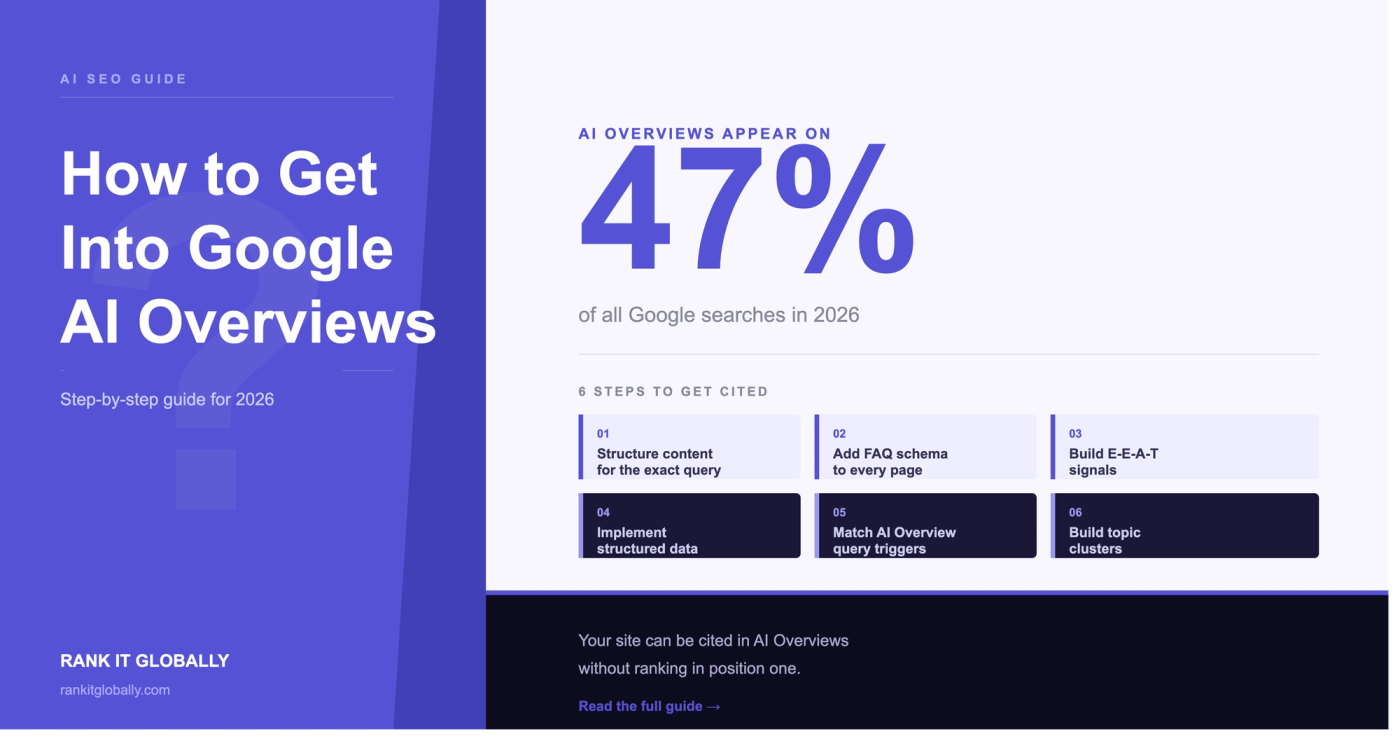
Google AI Overviews now appear on 47% of searches. Here is exactly how to get your business cited — schema, content structure, E-E-A-T signals, and real examples.
Google AI Overviews now appear on 47% of searches. Here is exactly how to get your business cited — schema, content structure, E-E-A-T signals, and real examples.
Quick Answer
To get into Google AI Overviews, your page needs three things: a direct answer to the target query within the first 150 words, FAQ schema markup with exact-match questions and self-contained answers, and sufficient E-E-A-T signals for Google to treat your site as a credible source. Pages do not need to rank in position one to be cited.
Getting into Google's AI Overviews requires structuring your content so Google's AI can extract, verify, and confidently cite it. The three non-negotiable requirements are: a direct answer to the target query within the first 150 words of the page, FAQ schema markup that matches the exact questions people search, and sufficient E-E-A-T signals — Experience, Expertise, Authoritativeness, and Trustworthiness — for Google to treat your site as a credible source.
AI Overviews now appear on approximately 47 percent of Google searches in the United States. They sit above all organic results, above paid ads, and above featured snippets. A business cited in an AI Overview receives visibility without needing to rank in position one. That is the opportunity — and most businesses are not yet structured to take it.
This guide covers the exact steps to make your content AI Overview-eligible, with a checklist you can apply to any page on your site today.
A Google AI Overview is a synthesised answer generated by Google's Gemini AI that appears at the top of search results for informational and commercial queries. It pulls from multiple web sources, cites them with links, and presents a consolidated answer to the user's query without requiring them to click through to any individual site.
Google AI Overviews were formerly called Search Generative Experience (SGE) during their 2023 to 2024 testing phase. They became the default search experience for US users in May 2024 and have since expanded across the UK, Canada, Australia, and other markets.
The key distinction from featured snippets is that AI Overviews synthesise across multiple sources. A page does not need to be ranked in position one to be cited — it needs to be structured correctly and trusted enough for Google's AI to use as a source.
AI Overviews change the economics of search visibility in three ways.
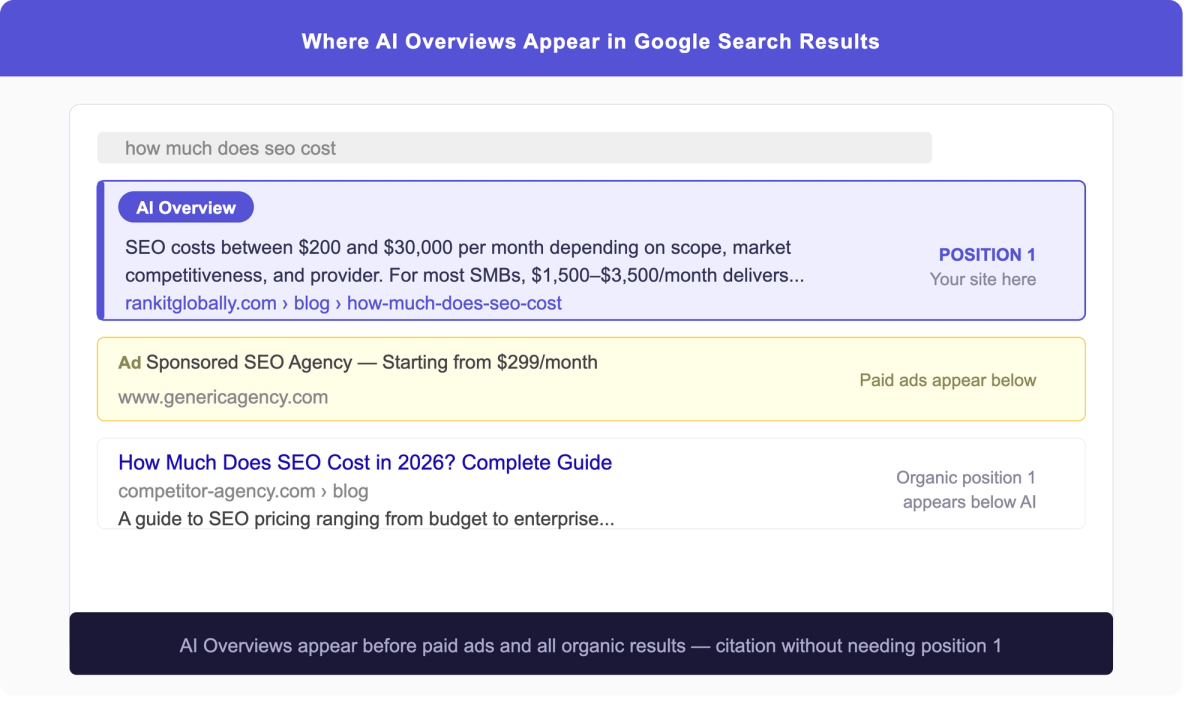
Google's AI pulls content that most directly answers the query a user typed. This means your page needs to contain the exact question and a clear, concise answer — not buried in paragraph three, but at the top of the page.
The structure that consistently earns AI Overview citations follows this pattern:
The H1 heading should match or closely mirror the search query. If someone searches "how to get into google ai overviews," the H1 should use that phrase or a close variant. Avoid creative headings that obscure the topic — "Unlock the Power of AI Search" tells Google nothing useful.
The first paragraph should answer the query directly in two to three sentences. Think of it as writing the answer you would want to appear in an AI Overview. If you would not be comfortable with that paragraph being quoted verbatim as the answer, rewrite it.
Each H2 section should address a sub-question related to the main query. Use the same phrasing your audience uses — not industry jargon, not creative chapter titles. Tools like Google Search Console, People Also Ask boxes, and AnswerThePublic show you the exact phrasing to use.
Short paragraphs of two to four sentences outperform long dense blocks in AI Overview citations. Google's AI extracts chunks of text, not entire sections. Every paragraph should stand alone as a useful piece of information.
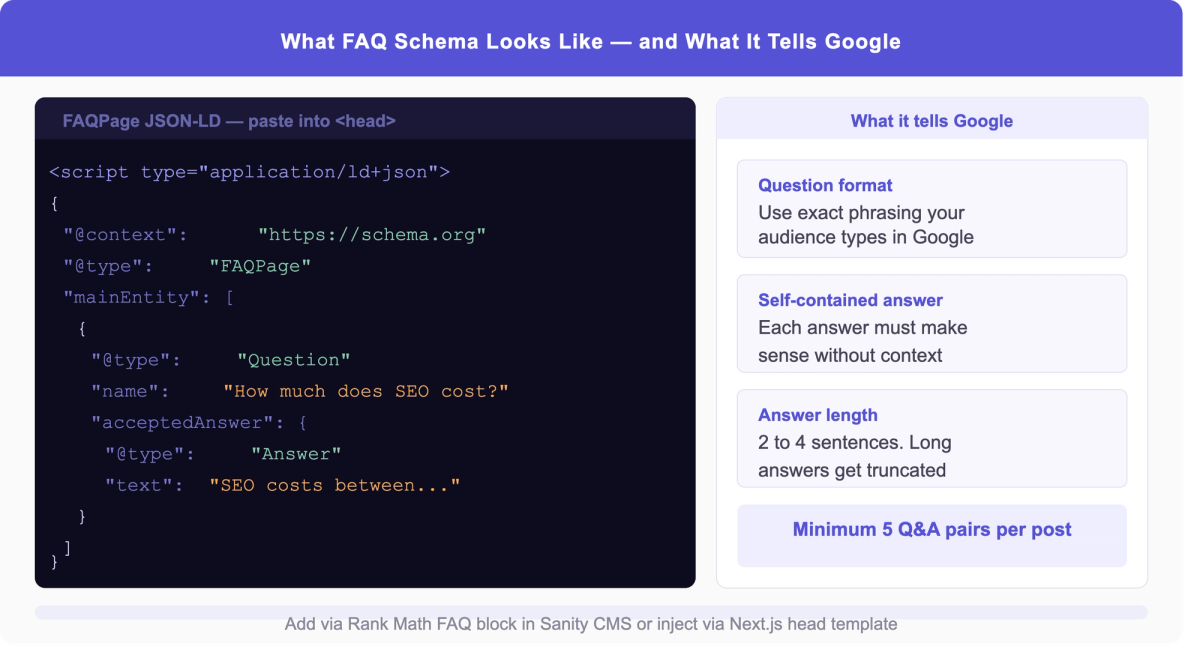
FAQ schema — also called FAQPage structured data — is the single most direct technical signal that tells Google's AI your content is structured as question-and-answer pairs. Pages with FAQ schema are significantly more likely to be cited in AI Overviews than equivalent pages without it.
FAQ schema is a JSON-LD code block added to your page's HTML. It lists questions and their answers in a format Google's crawlers can parse directly, independent of how the content is laid out visually on the page.
The questions in your FAQ schema must match the exact phrasing people use in search. Do not paraphrase. If the query is "how long does it take to appear in google ai overviews," that is the question. Write the answer in two to four sentences, directly and without filler.
Each FAQ answer should be self-contained. Google may pull just the answer text into an AI Overview without the surrounding context. If the answer only makes sense in context of the paragraph before it, rewrite it to stand alone.
For Sanity CMS users: add FAQ schema via a custom JSON-LD field in your post document or inject it dynamically via your Next.js front-end template, which is part of a broader SEO investment most businesses at this stage are already making.
E-E-A-T stands for Experience, Expertise, Authoritativeness, and Trustworthiness. It is Google's framework for evaluating whether a source is credible enough to cite in AI Overviews and featured positions.
Google added the first E — Experience — to the original E-A-T framework in December 2022. Experience refers to first-hand knowledge of a topic, not just theoretical expertise. A page written by someone who has actually done the thing they are writing about carries more weight than a page that aggregates information from other sources.
The signals Google uses to evaluate E-E-A-T include:
Author credentials are established through an author bio page that lists qualifications, industry experience, and verifiable achievements. Every post should have a named author with a link to their bio page.
Original data and case studies demonstrate first-hand experience. A page that references real client results — specific numbers, named businesses, verifiable outcomes — signals experience that AI cannot fabricate. This is one of the strongest E-E-A-T signals available to agencies and service businesses.
External citations of your content on authoritative sites build authoritativeness. When other credible sources reference your work, Google treats your site as a reliable source.
Consistent publishing on a defined topic cluster builds topical authority over time. A site with thirty interlinked posts on AI SEO signals deeper expertise than a site with one post on the topic, which is exactly what Answer Engine Optimisation is built around.
HTTPS, clear contact information, privacy policy, and terms of service are baseline trustworthiness signals. Their absence is a red flag to Google's quality systems.
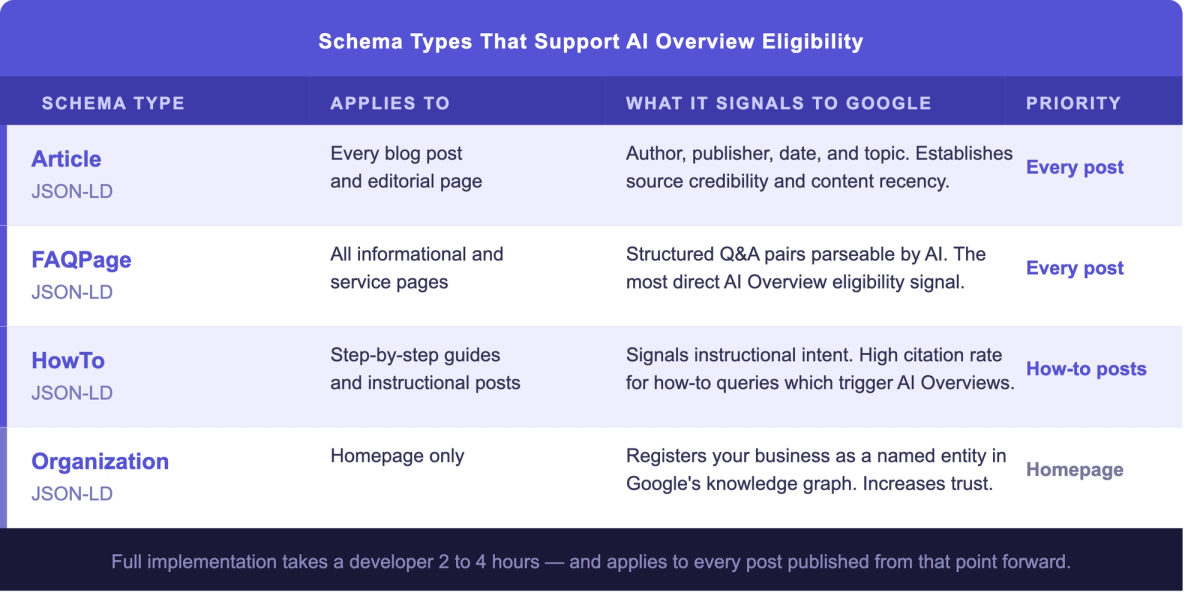
FAQ schema is the most direct path to AI Overview citations, but it is not the only structured data type that matters.
Article schema tells Google that a page is a piece of editorial content with an author, a publication date, and a publisher. It provides the metadata Google uses to evaluate recency and source credibility. Every blog post should have Article schema.
HowTo schema applies to step-by-step guides and signals that the content is instructional. Pages with HowTo schema are frequently cited in AI Overviews for "how to" queries — which represent a significant share of AI Overview-triggering searches.
Organization schema on your homepage establishes your business as a named entity in Google's knowledge graph. Once your business is recognised as an entity, Google can cite your content with higher confidence about the source's identity.
BreadcrumbList schema on all pages helps Google understand your site's content hierarchy, which supports topical authority signals.
For most small and medium business websites, implementing these four schema types covers the majority of AI Overview eligibility requirements. Full implementation typically takes a developer two to four hours.
Not all search queries trigger AI Overviews. Understanding which query types consistently produce AI Overviews helps you prioritise which pages to optimise first.
Queries that most reliably trigger AI Overviews are informational questions beginning with how, what, why, when, and which. Comparative queries such as "X vs Y" and "best X for Y" also trigger AI Overviews frequently. Definition queries — "what is [term]" — are among the most reliable triggers.
Queries that rarely trigger AI Overviews include branded searches, navigational searches (where the user is looking for a specific website), and highly transactional queries like "buy X" or "X near me."
To identify which of your existing pages have AI Overview potential: run your target keyword in an incognito Google search and check whether an AI Overview appears. If it does, that query is triggering AI Overviews and your page is a candidate for citation if it meets the structural requirements. If it does not, the query is not currently an AI Overview trigger — focus your effort elsewhere.
Queries where your business can most realistically earn AI Overview citations are mid-competition informational terms where you have genuine expertise and can provide more specific, experience-backed answers than the current cited sources.
A single well-optimised page can earn an AI Overview citation. But a site with a complete cluster of interlinked content on a topic earns citations more consistently and more broadly across the full range of related queries.
A content cluster is a group of pages that collectively cover a topic in depth. It consists of a pillar page — a comprehensive overview of the main topic — and multiple cluster pages that cover specific subtopics in detail. Every cluster page links back to the pillar. The pillar links out to every cluster page.
For a digital marketing agency, an AI SEO content cluster might look like this:
The pillar page covers AI SEO comprehensively: what it is, why it matters, the full range of optimisation techniques, and how it differs from traditional SEO. The cluster pages each cover one specific aspect in depth: getting into AI Overviews, FAQ schema implementation, E-E-A-T signals, AEO for local businesses, schema for e-commerce, and so on.
Google reads this network of interlinked content and concludes that the site has genuine, deep expertise on the topic — not just one page that covers the basics. That topical authority signal is one of the most reliable pathways to consistent AI Overview citations across a topic cluster.
At Rank It Globally, our AI SEO service is built on exactly this cluster architecture. Clients who combine technical schema implementation with a properly structured content cluster consistently earn AI Overview citations within sixty to ninety days of the cluster going live.
Appearing in Google AI Overviews typically takes between thirty and ninety days from the point at which all optimisation steps are in place. The timeline depends on three factors: how quickly Google re-crawls and re-indexes the optimised pages, the existing authority of the domain, and the competitiveness of the target queries.
Sites with a domain rating above forty and an existing content presence can see AI Overview citations in as few as two to four weeks for low-competition queries. New domains or thin sites may take four to six months.
The fastest results come from combining all six steps in this guide simultaneously rather than implementing them sequentially.
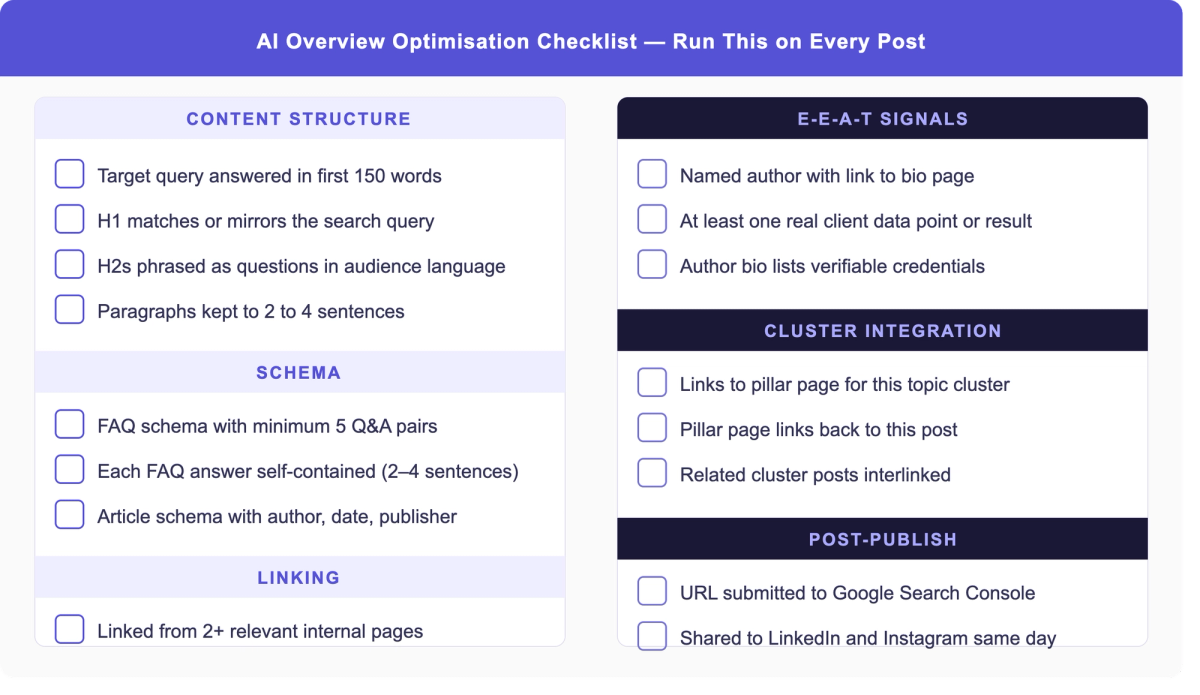
Before leaving this page, run your target post or page against this checklist:
The target query is answered directly in the first 150 words. Each H2 heading is phrased as a question using the same language your audience uses. FAQ schema is implemented with a minimum of five question-and-answer pairs. Each FAQ answer is self-contained and two to four sentences long. Article schema is in place with author, date, and publisher fields complete. An author bio page exists with verifiable credentials and is linked from the post. At least one piece of original data or a named client result appears in the content. The page is internally linked from at least two other relevant pages on the site. The pillar page for this topic cluster links to this page.
What is a Google AI Overview?
A Google AI Overview is a synthesised answer generated by Google's Gemini AI that appears at the top of search results. It pulls from multiple web sources, cites them with links, and presents a consolidated answer to the user's query. AI Overviews appear above all organic results and paid ads for informational and commercial queries.
How do I get my website into Google AI Overviews?
To get into Google AI Overviews, structure your content with a direct answer to the target query in the first 150 words, implement FAQ schema with exact-match questions and self-contained answers, build E-E-A-T signals through author credentials and original data, and develop a content cluster on your topic to establish topical authority with Google.
Does my website need to rank on page one to appear in AI Overviews?
No. Google's AI Overviews pull from sources it considers credible and well-structured, regardless of their organic ranking position. A page ranked seventh can be cited in an AI Overview if it answers the query more directly than pages ranked above it.
What is the difference between AI Overviews and featured snippets?
Featured snippets pull a single passage from one source and display it verbatim. AI Overviews synthesise information from multiple sources and present a generated summary, citing each contributing source with a link. A page can earn a featured snippet by ranking in the top three positions; earning an AI Overview citation depends more on content structure and source credibility.
What is FAQ schema and why does it matter for AI Overviews?
FAQ schema is structured data — written in JSON-LD format — that labels your content's question-and-answer pairs in a way Google's crawlers can parse directly. Pages with FAQ schema signal to Google that their content is structured as Q&A, which is the same format Google uses in AI Overview answers. It is one of the most direct technical signals for AI Overview eligibility.
How do I know if my page is being cited in AI Overviews?
Search for your target keyword in an incognito browser window. If an AI Overview appears and your site URL is listed in the source citations on the right side of the overview, your page is being cited. Google Search Console does not currently have a dedicated AI Overview report, but impressions from AI Overview positions appear within the standard Performance report.
What types of businesses benefit most from AI Overview optimisation?
Service businesses, agencies, and professional services firms benefit most because their target queries — "how to find a good X," "what does X cost," "how does X work" — are exactly the informational query types that most reliably trigger AI Overviews. E-commerce businesses benefit less because transactional queries trigger AI Overviews less frequently.
Google AI Overviews are not a future consideration — they are the current default for nearly half of all Google searches. Businesses that structure their content correctly, implement the right schema, and build topical authority through content clusters are earning brand visibility at the top of the search results page right now.
The six steps in this guide — direct answers, FAQ schema, E-E-A-T signals, structured data, query matching, and content clusters — are not experimental tactics. They are the observable common factors across pages that earn consistent AI Overview citations.
If you want to know whether your current site is structured to earn AI Overview citations, our free audit covers this as a specific component of the technical review.
Get Your Free AI Visibility Audit
Rank It Globally is an AI SEO and web design agency trusted by 150+ brands across the US, UK, UAE, and Canada. We build content architectures that earn citations in Google AI Overviews, ChatGPT Search, and Perplexity.

Written by
Share

Your site isn't on Google's first page - here are the real reasons why, ranked by impact, with the exact fixes to apply first so you stop losing leads to competitors.

Stop guessing SEO pricing. We break down every tier — $500/month to $30K+ — with real numbers and what you actually get at each level. No fluff, no hidden fees.