GEO vs SEO: How ChatGPT, Perplexity & Gemini Choose Which Businesses to Recommend
SEO gets you ranked. GEO gets you recommended. Here's how ChatGPT, Perplexity and Gemini decide which businesses to name, and the four signals you control.
SEO gets you ranked. GEO gets you recommended. Here's how ChatGPT, Perplexity and Gemini decide which businesses to name, and the four signals you control.
By Haroon Shahbaz, Founder of Rank It Globally · Published October 19, 2026 · Last updated October 19, 2026
How we put this together: every technical claim is checked against the platforms' own documentation (Google Search Central, OpenAI, Perplexity, Anthropic and Microsoft Bing) and published research, linked in the Sources section. The practical advice comes from the AI visibility audits we run for US small businesses across ChatGPT, Perplexity, Gemini and Google AI Overviews.
Disclosure: Rank It Globally sells AI SEO & GEO services. Everything in this guide can be done without hiring us.
Quick answer: GEO (generative engine optimization) is the work of getting your business named and cited inside AI answers from ChatGPT, Perplexity, Gemini and Google's AI Overviews. SEO earns you a ranked link; GEO earns you a mention in the answer itself. For small businesses, GEO doesn't replace SEO. It's built on top of it.
Key takeaways
Search engine optimization (SEO) is the work of helping your website rank in search engines like Google and Bing so people click through to you. It covers three areas: technical (can search engines crawl, load and index your pages?), content (do your pages answer what people search for?) and authority (do other sites, reviews and links vouch for you?). For local businesses it also includes your Google Business Profile and the Map Pack. If you want the full picture of how Google decides who ranks, our guide on why websites don't show up on Google covers it.
Generative engine optimization (GEO) is the practice of making your business easy for AI tools to find, understand, trust and quote, so that when someone asks ChatGPT, Perplexity, Gemini or Google's AI Mode for a recommendation, your name is in the answer.
The term comes from a 2023 research paper, GEO: Generative Engine Optimization, by researchers from Princeton University, Georgia Tech, the Allen Institute for AI and IIT Delhi, presented at the ACM KDD conference in 2024. They tested how different content changes affected whether a page showed up in AI-generated answers. Adding statistics, quotations and cited sources increased visibility by up to 40%, while keyword stuffing didn't help.
Mostly, yes. You'll see several names for the same goal of being the source an AI system chooses when it writes an answer:
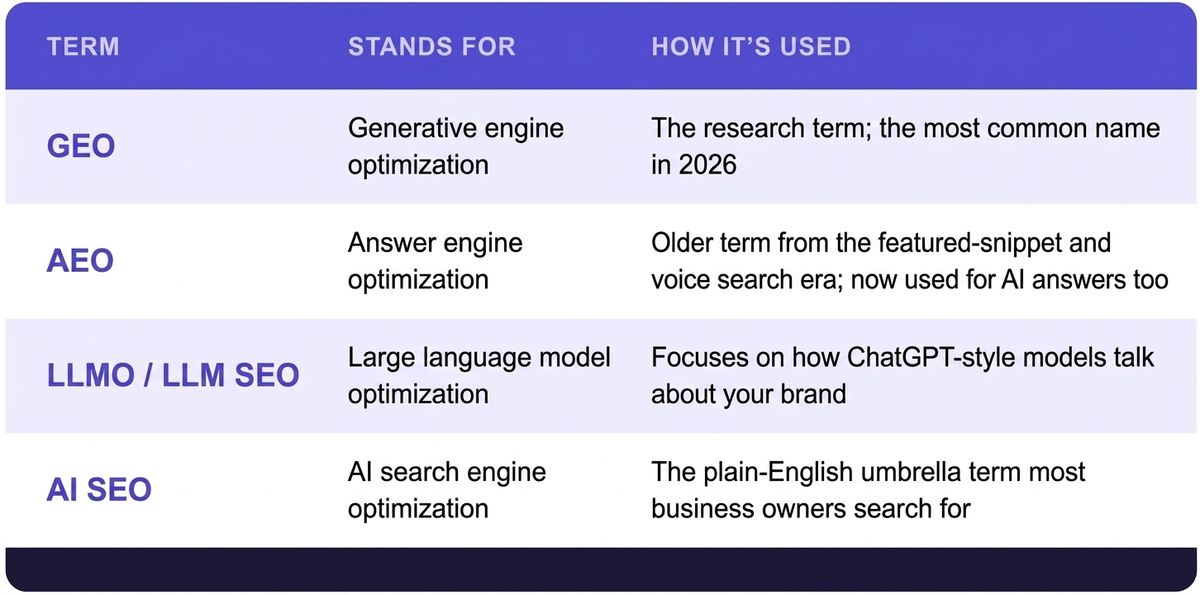
The labels differ; the work doesn't. In this guide we use GEO.
SEO and GEO share most of their foundation. The difference is what you're competing for and where the win shows up.
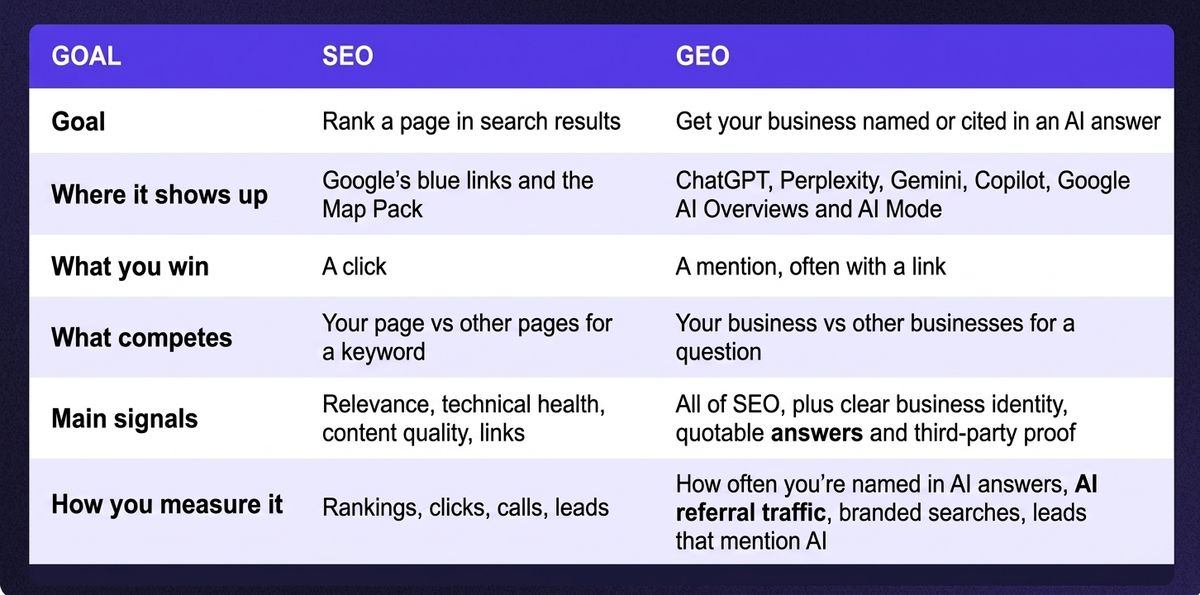
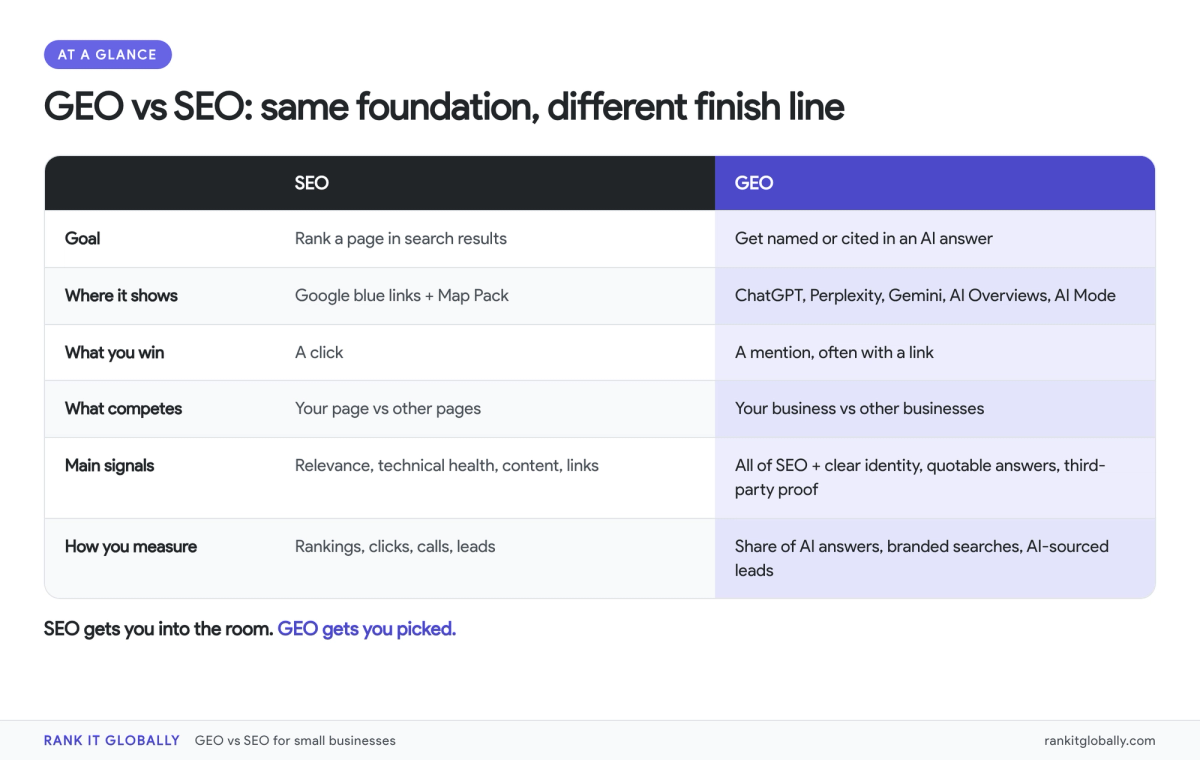
The simplest way to think about it: SEO gets you into the room. GEO gets you picked. A page that ranks on page four is invisible to both Google users and AI tools. A page that ranks well but buries the answer in vague copy may get the click from Google but lose the mention in an AI answer to a competitor who said it more clearly.
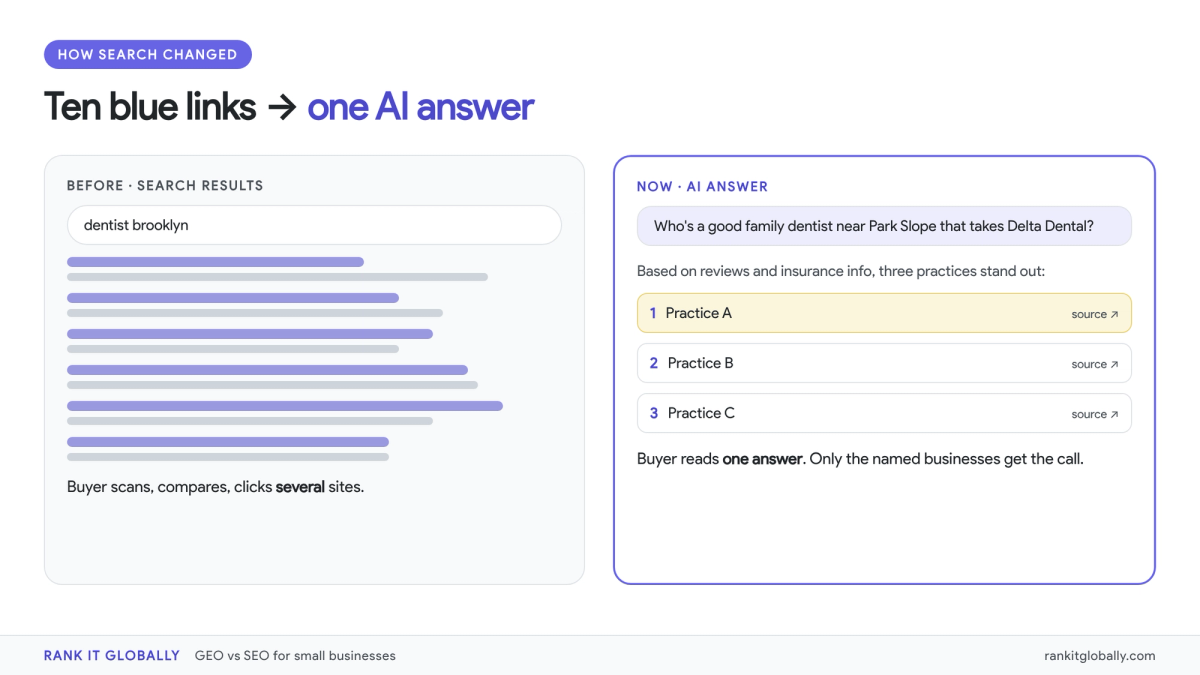
Your customers have changed how they ask. Instead of typing "dentist Brooklyn," they ask "Who's a good family dentist near Park Slope that takes Delta Dental?" Instead of scanning ten results, they read one answer.
For a local business, being one of the two or three names an AI answer mentions is the new top three of the Map Pack.
AI assistants know about businesses in two different ways, and GEO has to cover both:
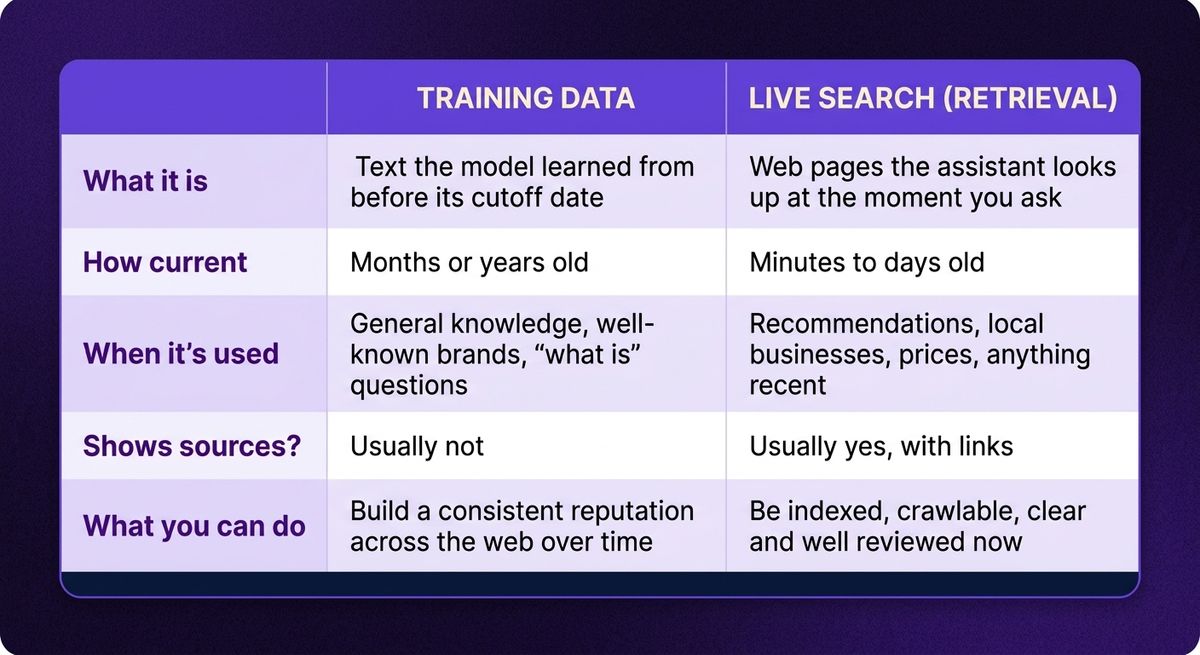
For a small business, live search matters most. Questions like "best plumber in Tampa" almost always trigger a web search, because the model can't rely on memory for local, changing information. That's good news: you don't have to wait for the next model to be trained. If your pages and profiles are fixed today, AI tools that search the web can pick them up within days or weeks.
Training data still matters in one way: if the web said something wrong or outdated about you years ago (an old address, a service you dropped), an AI can repeat it. Consistent, current information everywhere is how you correct that over time.
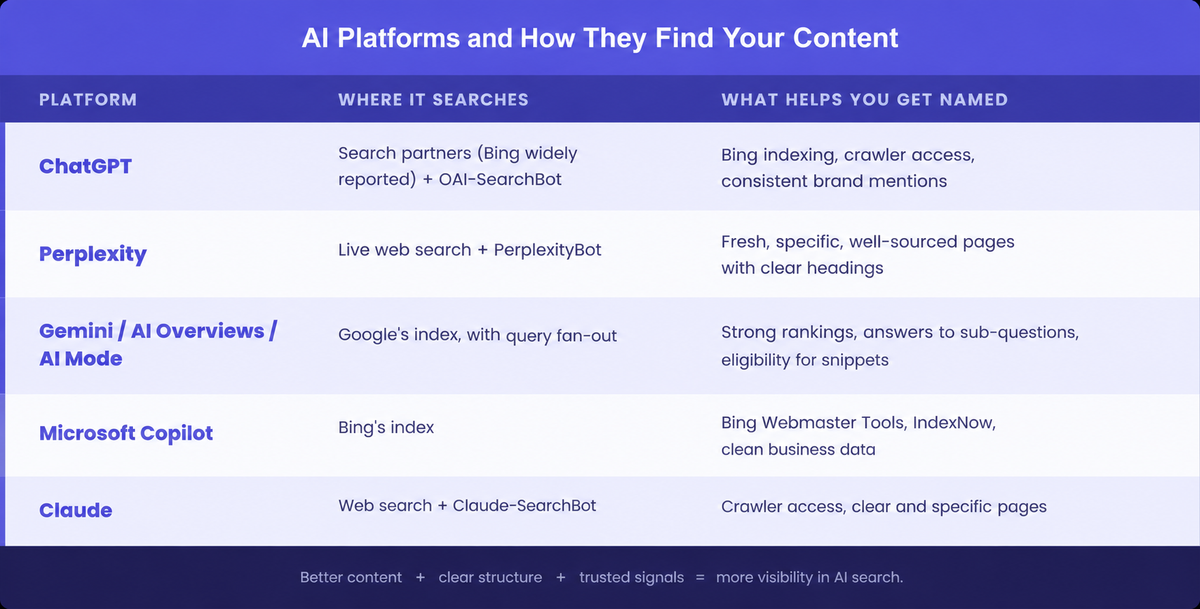
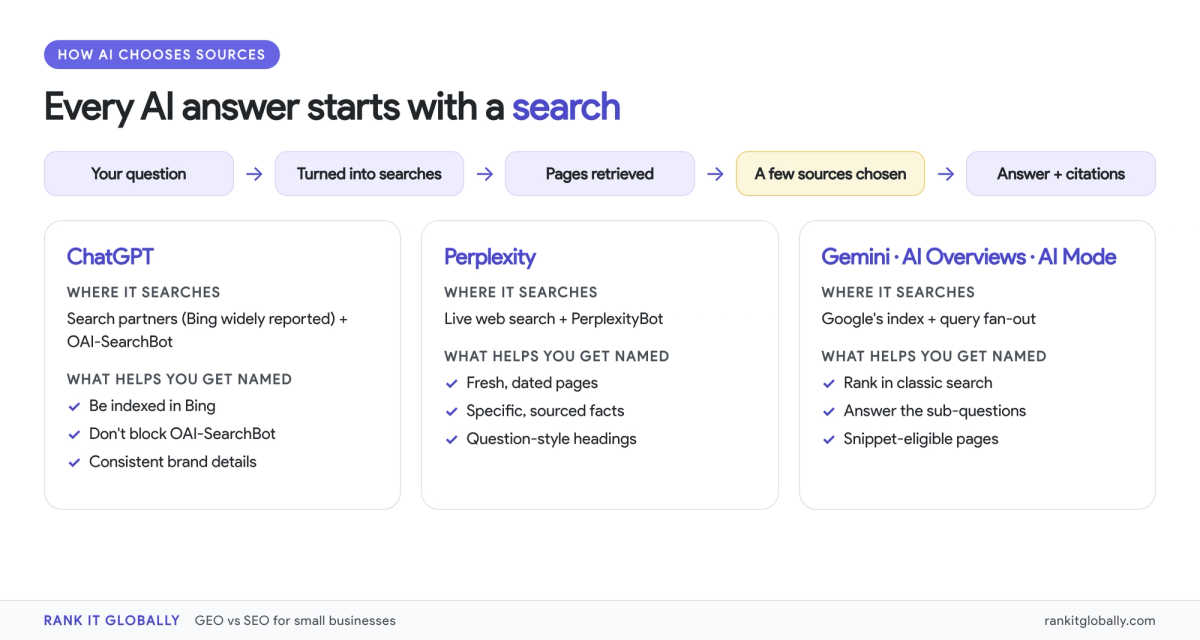
All three work in roughly the same way: they turn your question into one or more searches, pull back web pages, choose a handful of sources they trust, then write an answer from them. The differences are in where they search and what they favor.
When ChatGPT searches the web, it uses third-party search providers (Bing is widely reported as the main one) plus OpenAI's own crawler. According to OpenAI's crawler documentation, sites that opt out of OAI-SearchBot in robots.txt aren't shown in ChatGPT search answers (they can still appear as plain navigational links). OpenAI's separate GPTBot collects training data; blocking it doesn't remove you from ChatGPT search, because the two settings are independent.
Perplexity runs a live web search for most questions and shows numbered citations next to each claim. It uses its own crawler, PerplexityBot, to build its index, and Perplexity's documentation recommends allowing it if you want to appear in results. It tends to favor pages that are relevant, recent and specific, with facts it can attribute.
Google's AI features are built on Google's own index. Google describes AI Mode's "query fan-out" technique as issuing "multiple related searches concurrently across subtopics and multiple data sources," then bringing the results together into one answer. Google's official guidance says a page must be indexed and eligible to show a snippet to be used as a supporting link, and that there are no additional technical requirements beyond that.
Three Google surfaces are worth separating: AI Overviews are the AI summaries at the top of normal Google results; AI Mode is the separate conversational tab in Google Search; the Gemini app is Google's standalone assistant. AI Overviews and AI Mode are governed by normal Googlebot crawling and Search rules.
Microsoft Copilot answers from Bing's index, so the same Bing Webmaster Tools work that helps ChatGPT helps Copilot too. Anthropic's Claude can search the web and documents its own crawlers, including Claude-SearchBot for search and ClaudeBot for training. Other assistants built into phones, browsers and apps generally license results from Google or Bing. The practical takeaway: if you're solid in Google and Bing and you don't block AI search crawlers, you're covered almost everywhere.
How each platform finds sources
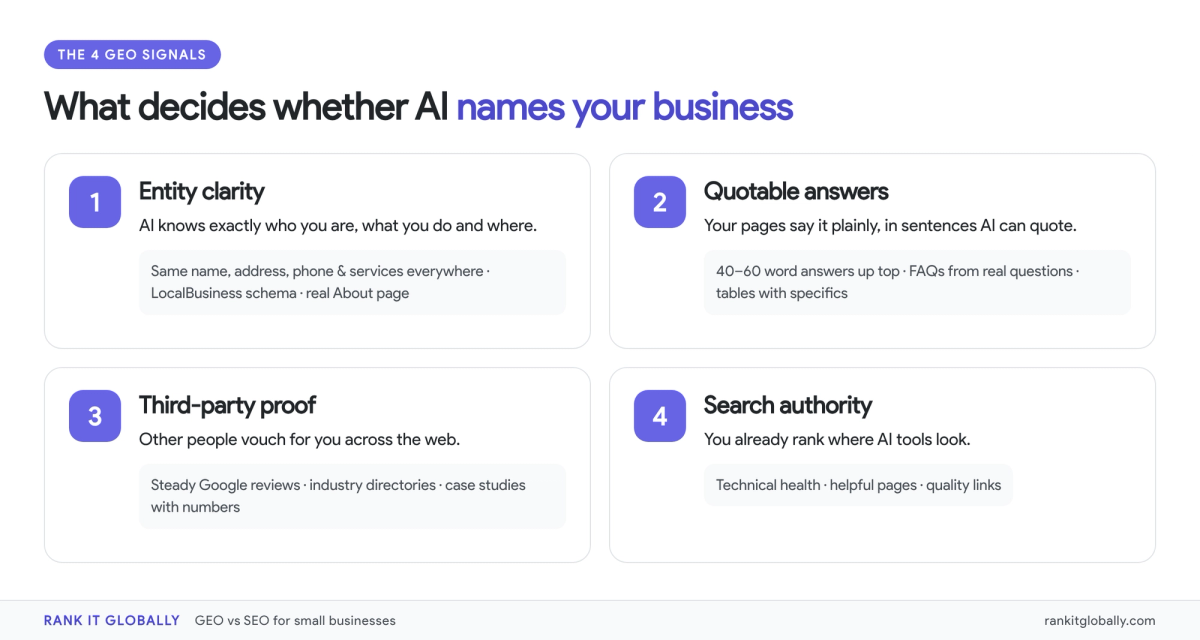
Across platforms, the businesses that get named consistently share four signals. These are the same four we work on in our AI SEO & GEO services.
AI tools need to connect your name to what you do, where you do it and who you serve. If your website says one thing, your Google Business Profile another and an old directory a third, the AI can't be confident, so it names someone else.
AI systems quote sentences that answer a question directly. A service page that opens with "We're passionate about excellence" gives them nothing to use. One that opens with "We repair and replace residential HVAC systems across Austin, usually within 24 hours" does.
AI tools weigh what the rest of the web says about you, not just what you say about yourself. Reviews, directory listings, local press, industry associations and case studies all count.
Most AI answers are built from pages that already perform in search. If your site has technical problems, thin pages or no links, fix that first. Our guide on why websites don't show up on Google covers the most common causes, and our SEO services page explains how we fix them.
Local questions ("emergency plumber near me," "dentist open Saturday in Round Rock") are where small businesses win or lose the most. For these, AI tools lean heavily on location and reputation data rather than blog content:
In short, local GEO is mostly local SEO done properly, plus making sure the details AI tools repeat about you are accurate.
Many small business sites block AI tools without knowing it, often through a security plugin, a firewall or a copied robots.txt file. Here's what each major crawler does:
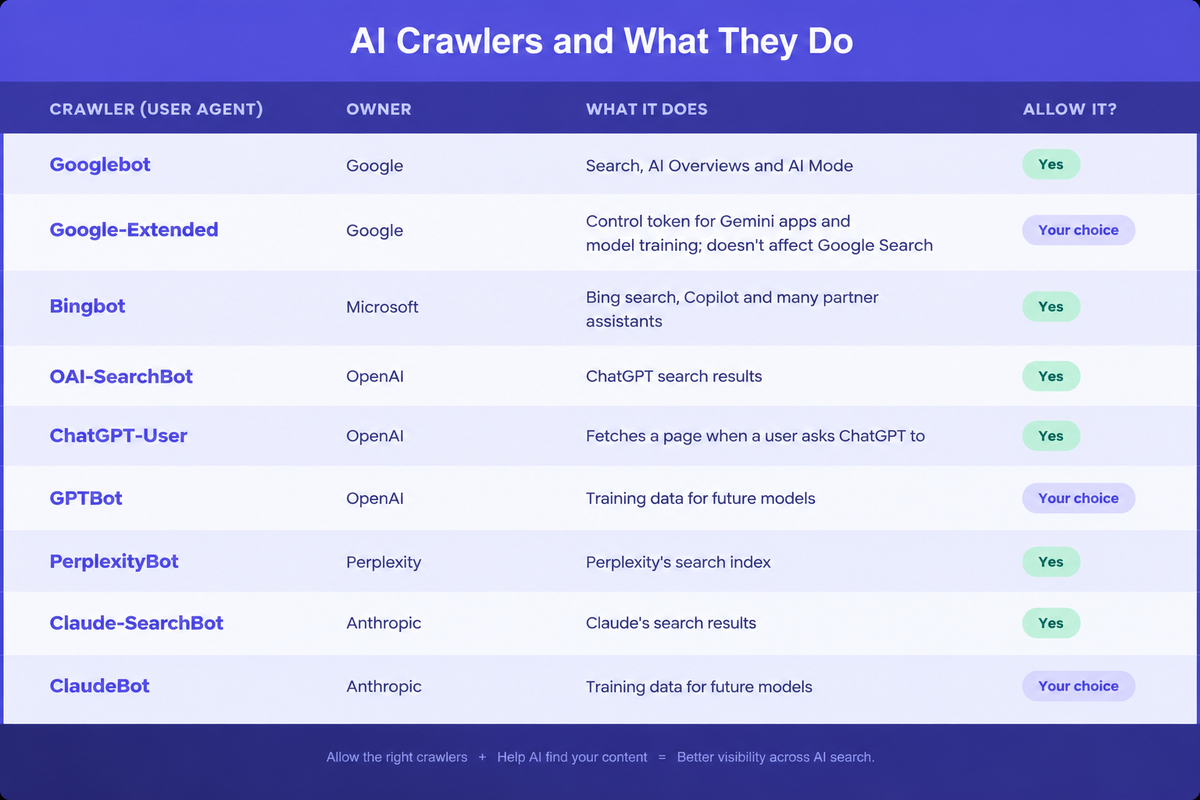
"Your choice" crawlers only affect model training, not whether you're shown in search answers. Sources: Google, OpenAI, Perplexity, Anthropic. A simple robots.txt that keeps every search crawler in looks like this:
CODE BLOCK (USE SANITY'S CODE BLOCK, LANGUAGE: PLAIN TEXT)
User-agent: *
Allow: /
# Optional: opt out of model training only
# User-agent: GPTBot
# Disallow: /
Sitemap: https://www.yourbusiness.com/sitemap.xml
Then work through the rest of the technical basics:
AI answers are assembled from small, self-contained pieces. The content formats that get cited most often in our audits share one trait: each section makes sense on its own.
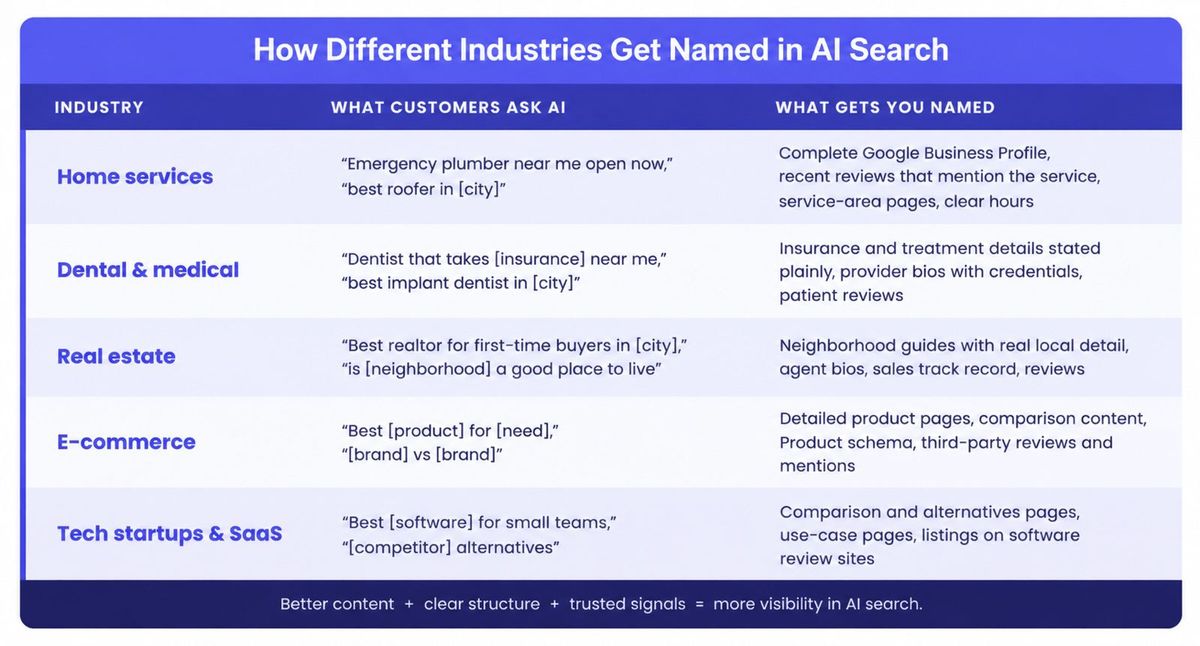
The four signals apply everywhere, but what customers ask AI, and what AI looks for, changes by industry:
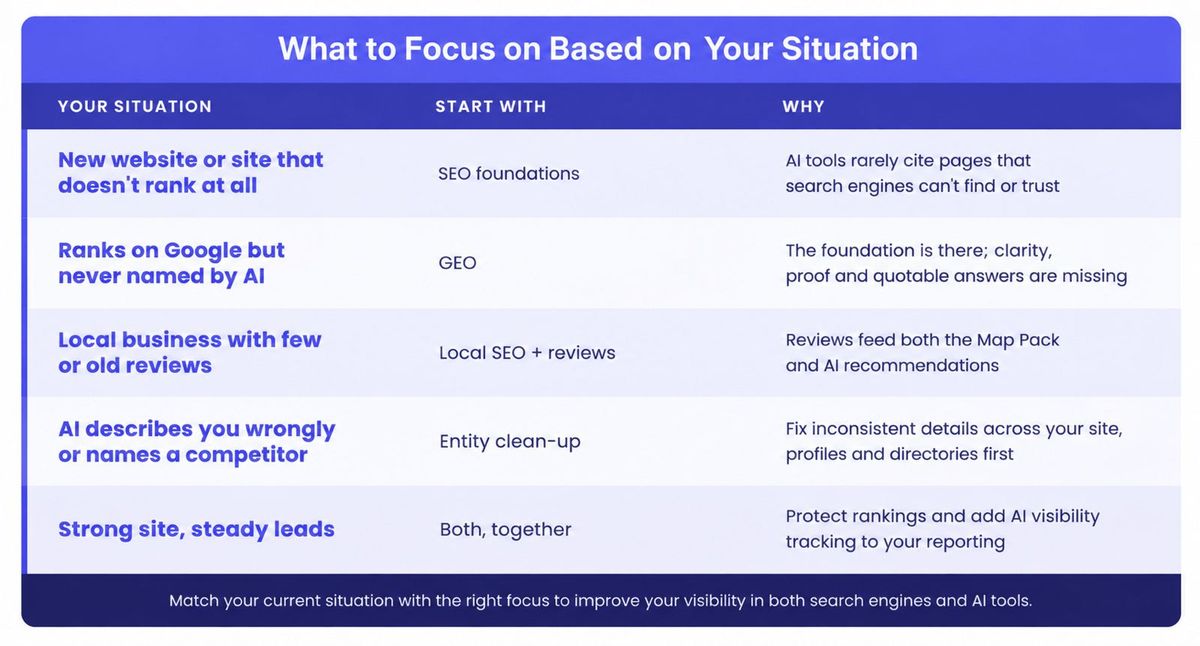
You rarely have to choose, because most of the work overlaps. But the order matters. Use this to decide where to start:
GEO is not a separate trick layered on a weak website. Google's own guidance is that existing SEO fundamentals remain worthwhile for its AI features, and no special markup is required. A few myths to skip:
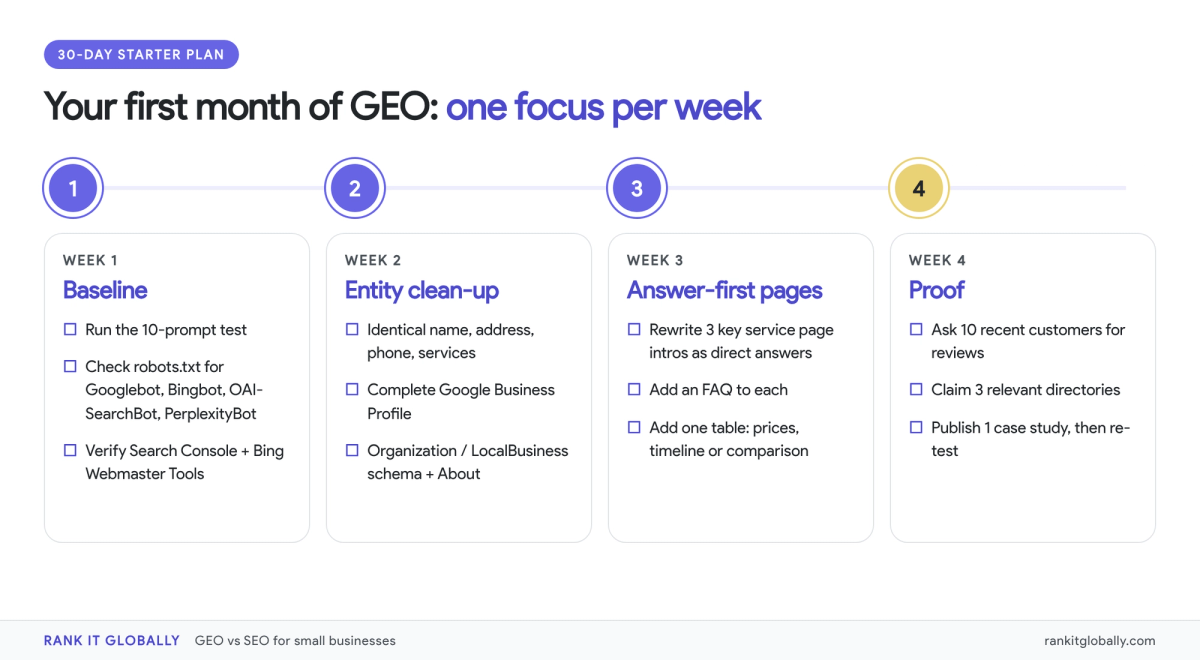
You don't need a big budget to start. One focus per week:
Open a private browser window (so your history doesn't skew results) and ask each AI tool the questions your customers would ask. Swap in your service, city and business name:
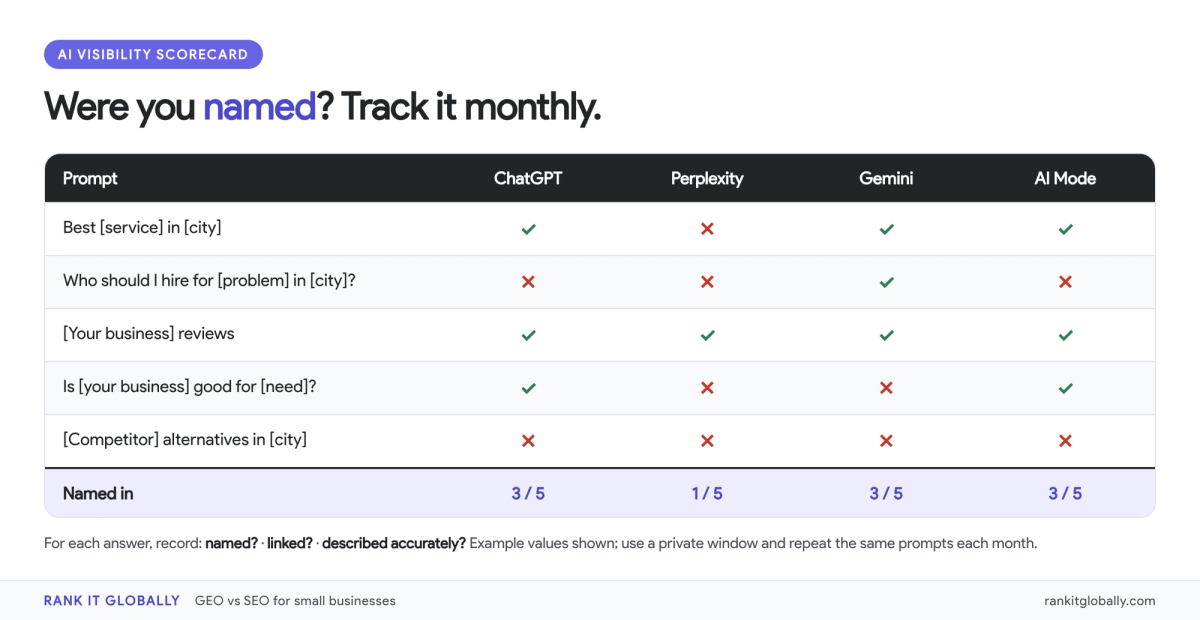
For each answer, record three things: Were you named? Was your site linked? Was the description accurate? Also note which sources the AI cited, because those are the sites to improve or get listed on. Track the totals monthly. AI answers vary from run to run, so the trend matters more than any single result.
Prompt tests show whether you're named. These free tools show whether it's turning into visibility and leads:
Google now treats AI features as part of Search performance. The Search Console reports below are from two of our clients, unedited. Look at the bottom line of each: Google links directly to "performance in generative AI features on Google Search."
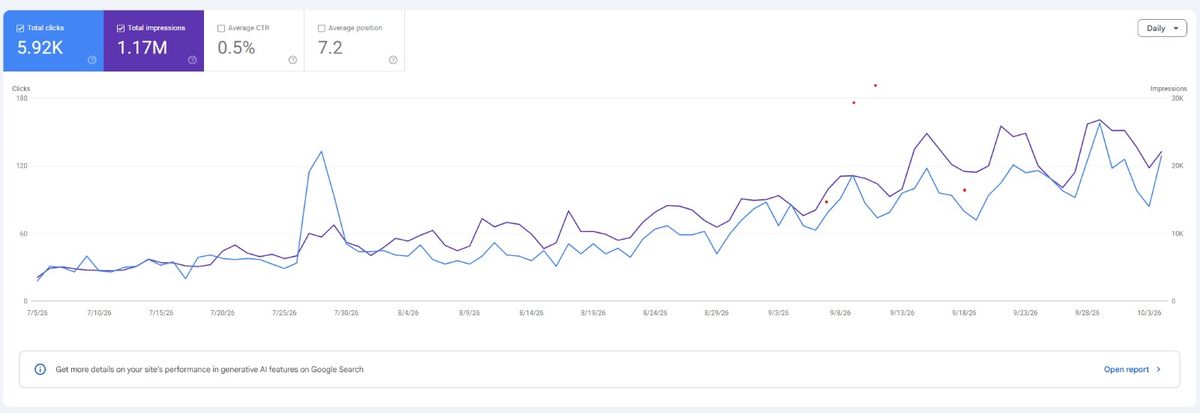
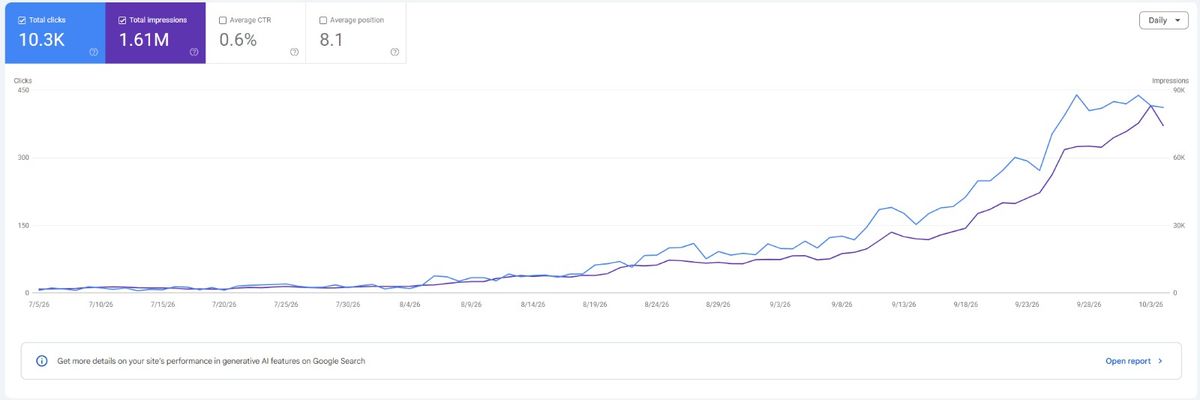
Both sites earned this the way GEO is earned: a technically sound site, pages that answer questions directly, and steady authority, so they show up wherever Google and AI tools look for answers.
When we run AI visibility audits for new clients, testing their customers' real questions across ChatGPT, Perplexity, Gemini and Google AI Overviews, the same problems come up again and again:
Every one of these is fixable with the four signals above. See more results on our case studies page.
Timeline. Technical fixes (crawler access, Bing indexing, schema) can be picked up by AI tools that search the web within days to a few weeks. Entity clean-up and answer-first rewrites usually show in prompt tests within one to two months. Reviews, mentions and rankings build over months. For most small businesses, plan on measuring progress over a 90-day window, against a baseline taken on day one.
Cost. GEO costs depend on how much SEO groundwork your site already has. If your site ranks and your business details are clean, GEO is mostly content and proof work and can run alongside an existing SEO budget. If your site doesn't rank, the SEO foundation comes first, and that's where most of the budget goes. Our guide to how much SEO costs breaks down typical budgets, and you can start for free with the 30-day plan above.
AI search hasn't replaced SEO. It has raised the bar for it. The businesses AI tools recommend are the ones that are easy to find, easy to understand and backed by proof from other people. Fix those three things and you'll win both the ranking and the recommendation.
Common Questions
No. GEO is built on SEO. AI tools like ChatGPT, Perplexity and Gemini search the web before answering and mostly cite pages that already rank and are easy to understand. Strong SEO is the foundation; GEO adds the clarity, quotable answers and third-party proof that make AI tools choose you.
They describe the same goal. AEO (answer engine optimization) and GEO (generative engine optimization) both mean optimizing your business and content so AI-powered answer tools cite or recommend you. GEO is the term used in the original research; AEO is older and common in marketing.
For recommendation questions, ChatGPT usually searches the web, using search partners and OpenAI's OAI-SearchBot crawler, then names businesses that appear in trustworthy sources: your website, review sites, directories and articles. Consistent business details, strong reviews and clear service pages make you more likely to be named.
Expect to measure progress over two to three months, not days. Fixes like crawler access and consistent business details can help quickly, while authority signals such as reviews, mentions and rankings build over time. Track a fixed set of prompts monthly to see the trend.
Yes, if customers ask AI tools for recommendations in your category. Questions like "best plumber near me" or "family dentist that takes my insurance" now get AI answers that name only a few businesses. Being one of them works like being in the top three of the Map Pack.
No special file is required. Google says its AI features have no extra technical requirements beyond normal SEO, and no major AI search product has confirmed using llms.txt to choose recommendations. Standard schema such as Organization, LocalBusiness and FAQ markup still helps tools understand your business.
Not in search answers. GPTBot and Google-Extended control whether your content is used for AI model training. ChatGPT search uses OAI-SearchBot, and Google AI Overviews and AI Mode use normal Googlebot crawling. Keep those search crawlers allowed if you want to be recommended.
Yes. Ask ChatGPT, Perplexity, Gemini and Google AI Mode the questions your customers ask, in a private browser window, and record whether you're named, linked and described accurately. Repeat the same prompts monthly, because AI answers vary between runs.
You can't edit an AI answer directly, but you can fix its sources. Find which sites it cites, correct your details on your website, Google Business Profile and directories, and publish clear, current information. AI tools that search the web usually pick up the corrections over the following weeks.
It depends on how much SEO groundwork your site already has. If your site ranks and your business details are clean, GEO is mostly content and proof work. If not, the SEO foundation comes first. Our guide to how much SEO costs breaks down typical budgets.

Written by
Share

Your site isn't on Google's first page - here are the real reasons why, ranked by impact, with the exact fixes to apply first so you stop losing leads to competitors.

Google AI Overviews now appear on 47% of searches. Here is exactly how to get your business cited — schema, content structure, E-E-A-T signals, and real examples.

Stop guessing SEO pricing. We break down every tier — $500/month to $30K+ — with real numbers and what you actually get at each level. No fluff, no hidden fees.